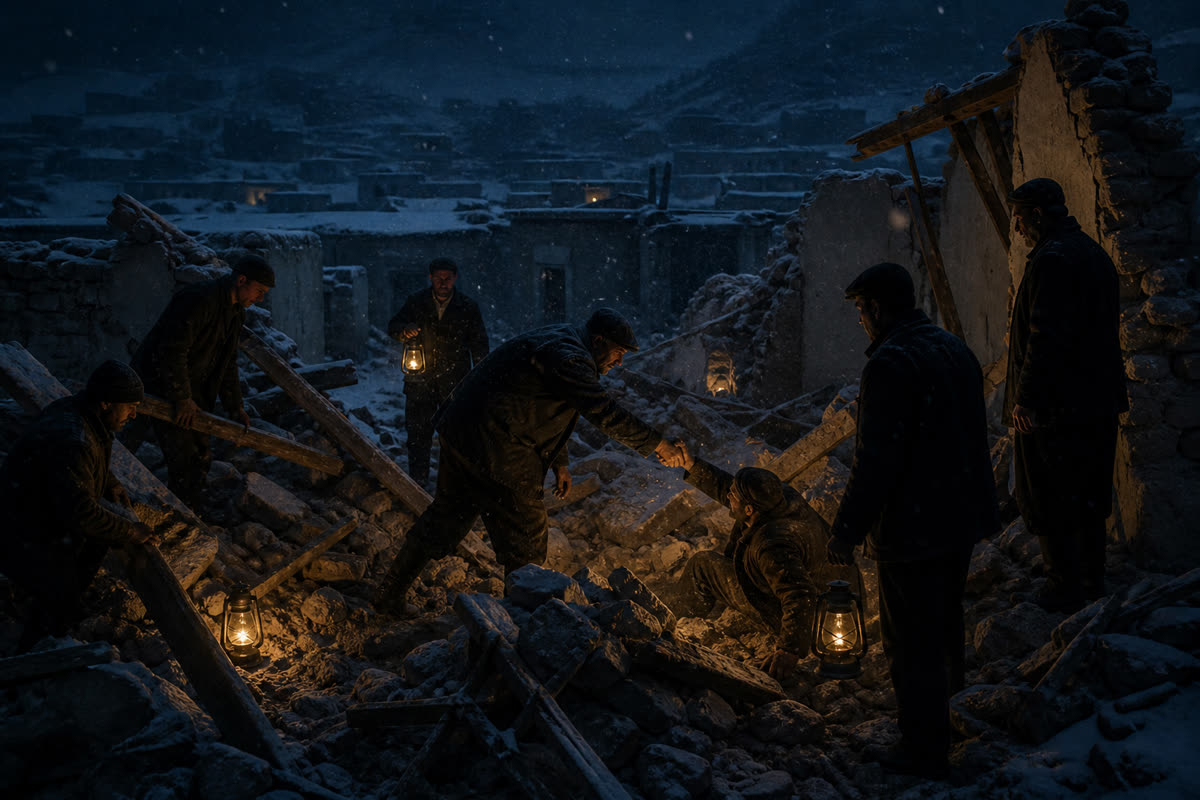
In the early hours of December 27, 1939, a massive earthquake devastated the city of Erzincan, Turkey, destroying the local prison and leaving its surviving inmates without walls, guards, or restraint. Despite the total collapse of authority and infrastructure, the prisoners did not flee; instead, they spent days pulling survivors from the rubble and returned each evening to be accounted for by the public prosecutor.
At 1:57 a.m., the North Anatolian Fault ruptured across 360 kilometers, leveling the city in two minutes. The official death toll reached 32,968, with over 116,000 buildings destroyed, including the prison. For the survivors, the chaos of a mid-winter night with temperatures plummeting to minus thirty degrees Celsius offered an unparalleled opportunity for escape. Yet, the story recorded in the media of 1940 was not one of mass flight, but of unexpected service.
Why did the prisoners not escape when given the chance?
The prisoners did not escape because the destruction of the city transformed their role from social outcasts into essential contributors to a communal survival effort. Contemporary press reports provide a vivid account of this transition. On January 3, 1940, the newspaper Akşam reported that even though the prison walls had fallen, not a single inmate attempted to leave. According to the Tan newspaper, Prosecutor İzzet Akçal gathered the survivors—including forty men transferred from İmralı prison—and assigned them to rescue teams. They worked tirelessly, recovering bodies and saving hundreds of injured citizens. Another report from Son Posta noted that fifty prisoners working on construction sites outside the prison walls saved over a thousand people from collapsing homes and provided shelter to victims in their own barracks.
Is the story of the prisoners returning to custody a legend or a recorded fact?
The core narrative of the prisoners remaining to work and reporting for roll call is a documented historical fact, even if some of the more cinematic details have evolved into legend over time. While modern internet accounts often claim the prosecutor gave a dramatic speech releasing the men for a day, there is no contemporary evidence for this specific dialogue. It appears in a newspaper column published sixty years later, in 1999. However, the journalistic records from January 1940 confirm that the prisoners were active in the rescue operations and voluntarily presented themselves to the authorities for counting. The reality was that the earthquake had already rendered the prison walls obsolete; the authorities merely managed this de facto situation by organizing the men into rescue squads.
How did the state respond to the prisoners' sacrifice?
The state recognized the inmates' contributions through both legislative action and formal clemency. On January 10, 1940, the Turkish Parliament enacted Law No. 3768, which postponed the execution of prison sentences in the disaster zone, acknowledging that it was both impossible to house inmates in destroyed facilities and necessary for them to assist their affected families. Following this, in April 1940, the government passed a special law granting an eighty percent reduction in sentences to 241 prisoners who had rendered 'extraordinary service' during the rescue efforts. A further 36 individuals were added to this list through supplementary laws in 1941. In total, 277 inmates, including those convicted of serious crimes like homicide and robbery, had their sentences significantly reduced in recognition of their humanitarian efforts.
What does the Erzincan case reveal about human behavior in disasters?
The Erzincan case demonstrates that the widely held belief in mass post-disaster panic and looting is largely a myth, as researchers in disaster sociology have frequently found that extreme events often trigger a powerful sense of communal solidarity. Charles Fritz, a pioneering American researcher who studied the Blitz in London, concluded that the shared experience of loss and deprivation breaks down social isolation, giving survivors a sense of belonging that is rarely found in ordinary times. Sociologist Enrico Quarantelli documented that in almost every major disaster, the initial rescue work is performed by ordinary citizens and neighbors long before professional responders arrive. Author Rebecca Solnit described this phenomenon as the creation of a 'paradise built in hell,' where the competitive, alienating nature of daily life is suspended in favor of a clear, shared purpose. In Erzincan, the prisoners were not immune to this effect; once the artificial barrier of their criminality was secondary to the urgent, existential need for human life, they integrated into the community to save it.
Erzincan saw the collapse not only of prison walls but of the invisible barriers separating the incarcerated from society; once that divide was breached through service, the prisoners chose to remain as participants in a rescue community.
Notes and Sources
- Kaya, F. (2014). '1939 Erzincan Büyük Depremi', Atatürk Araştırma Merkezi Dergisi, XXX(88); Pamir, H. N. & Ketin, İ. (1941) seismic reports.
- Akşam (January 3, 1940); Tan (January 3, 1940); Vakit (January 3, 1940); Son Posta (January 4–5, 1940); Cumhuriyet (January 6, 1940).
- Bozdemir, A. (1999). 'İnsanlık Dersi', Hürriyet, August 18, 1999; Yavuz, C. (2015). '1939 Erzincan Depremi Kurtarma Çalışmalarında Yer Alan Mahkûmların Affı Bağlamında Türkiye'deki Af Uygulaması', Türkiye Barolar Birliği Dergisi, 119, 88-96.
- Law No. 3768 (January 10, 1940), TBMM Records; Law No. 3804 (April 19, 1940); Law No. 3999 (April 14, 1941); Law No. 4162 (December 26, 1941), Resmî Gazete.
- Fritz, C. E. (1961/1996). 'Disasters and Mental Health: Therapeutic Effects of Disasters on Mental Health', University of Delaware Disaster Research Center.
- Quarantelli, E. L. (1954). 'The Nature and Conditions of Panic', American Journal of Sociology, 60(3), 267-275.
- Solnit, R. (2009). A Paradise Built in Hell: The Extraordinary Communities That Arise in Disaster, Viking.