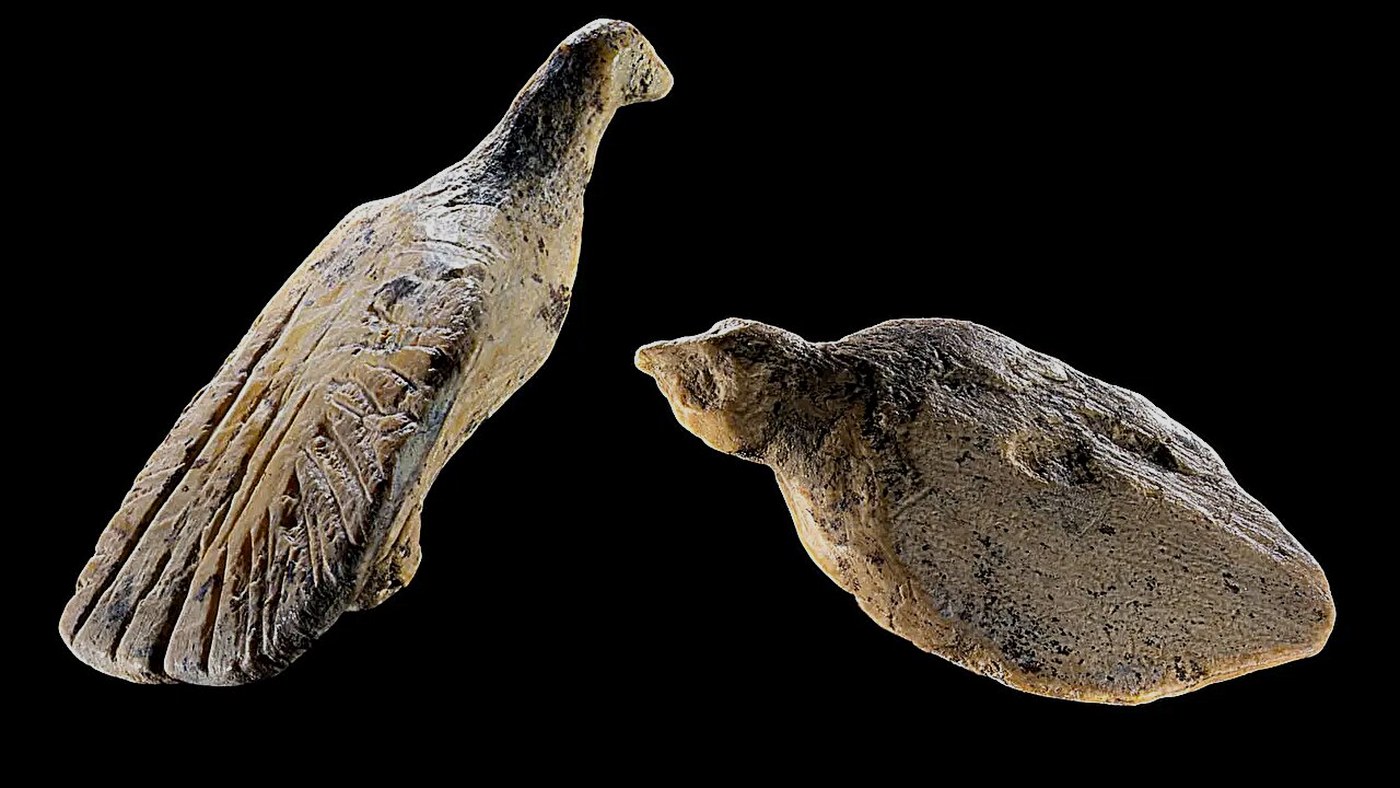
Two bird figurines, each no larger than a fingernail, have been discovered in the Hohle Fels cave, a limestone site in the Swabian Jura of southwestern Germany. Unearthed by a team from the University of Tübingen during the 2025 excavation season, the two ivory carvings were found in the same geological layer, separated by approximately 1.5 meters. Both items date back to the Aurignacian period, roughly 40,000 years ago.12
Museum officials and university researchers have hailed the artifacts as the discovery of the year. Their significance lies partly in their extraordinary scale. Measuring approximately 2 by 1 by 0.5 centimeters, these figures are significantly smaller than typical animal carvings from the same era, which usually range from 3 to 9 centimeters in length. Weighing 1.3 grams and 0.7 grams respectively, the two objects combined total just 2 grams.1
- The physical specifications, weight, and archaeological context of the findings.
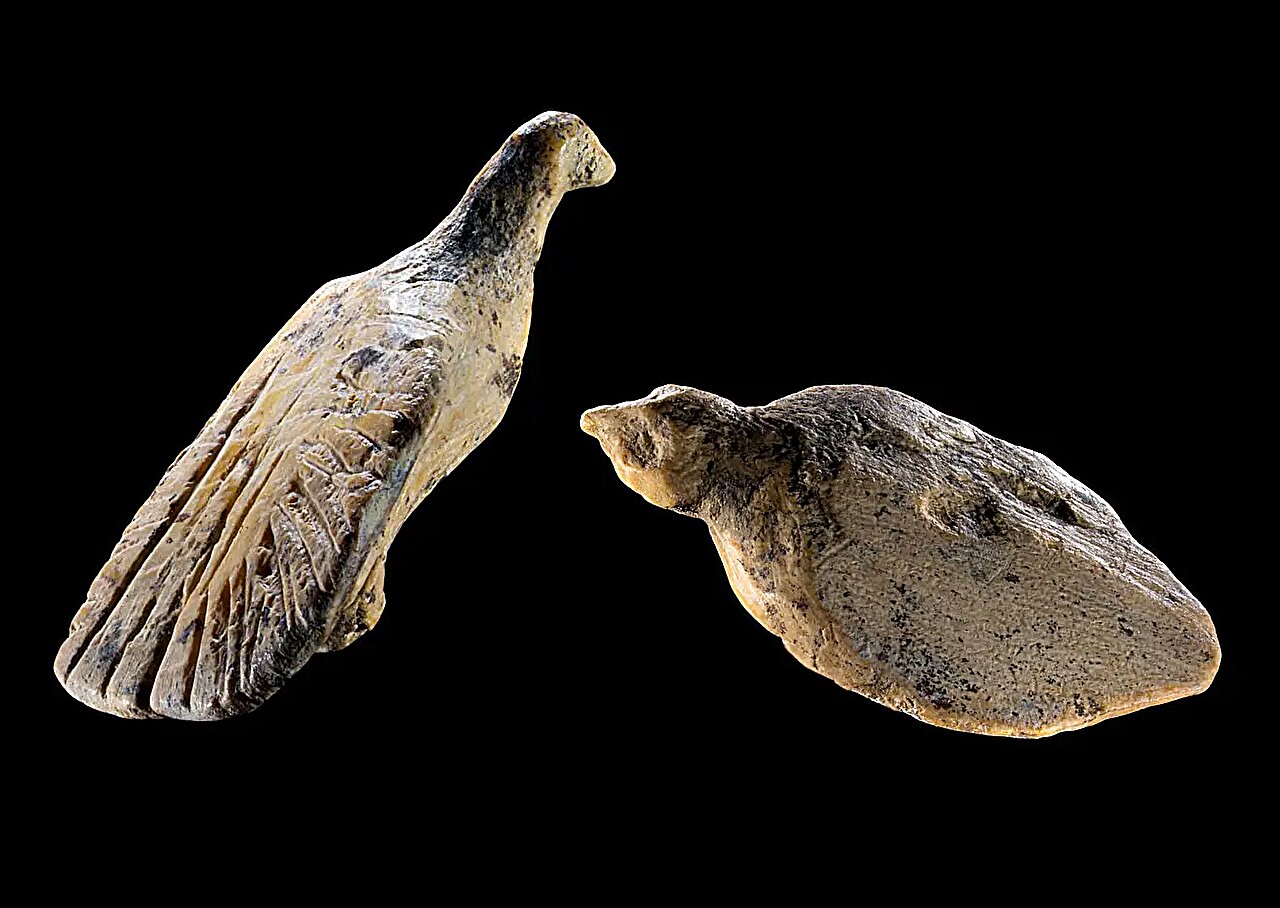
- Details visible in the resting bird and the bird with outstretched wings.
- The unique concentration of bird figurines at the Hohle Fels site.
- Theories regarding their purpose, from personal talismans to social identifiers.
What do the bird figurines reveal about Ice Age craftsmanship?
The more complete figurine depicts a bird resting, perhaps nesting, with clearly defined eyes. According to lead archaeologist Professor Nicholas Conard, the carving is not a stylized silhouette but a specific representation that invites analysis of species and movement. The second figurine is partially incomplete, with a broken left wing, but retains visible traces of open wings, a beak, and line markings that denote feathers. Whether the piece depicts flight, landing, or a mating display remains a subject of ongoing interpretation.12
While many early ivory animal carvings from the Swabian Jura are characterized by rigid, static poses, these two birds appear captured in specific moments. The intentional detail in the eyes, beaks, and feather lines suggests that the sculptor was intimately familiar with live birds. The resting bird bears a resemblance to the ptarmigan, a species frequently found in the faunal remains at Hohle Fels, though experts remain cautious about definitive species identification. Conard emphasizes the technical mastery required to execute such intricate motifs on mammoth ivory 40,000 years ago, noting that the region's caves often feature distinct animal assemblages.1
Mammoth ivory is a dense, grained material. Carving eye sockets, thinning wing edges, and etching feather patterns within a two-centimeter space requires immense patience, even by modern standards. Forty thousand years ago, this work was performed using only stone and bone tools. It is possible the same individual carved both pieces, given their proximity in the same archaeological layer and stylistic similarity, though definitive proof remains elusive.2
Why is the Hohle Fels cave significant for bird figurines?
Hohle Fels is renowned for more than just these avian carvings. The site has provided some of Europe's oldest figurative art, including early flutes and the famous Venus of Hohle Fels, serving as a comprehensive archive of early modern human activity in the Upper Danube region. With this discovery, the total number of carefully crafted bird carvings identified at the site rises to three. Other UNESCO-listed caves in the region contain abundant carvings of mammoths, cave lions, bears, horses, fish, and bison, but bird figurines are exceptionally rare and currently unique to Hohle Fels.13

Conard argues that this distribution is not random. Each of the four World Heritage caves appears to possess a distinct artistic signature tied to its own geographical and social context. Birds were part of the daily environment for these prehistoric inhabitants, recognized by their songs, migratory patterns, and warning calls. Stefanie Kölbl, director of the Prehistoric Museum in Blaubeuren, notes that these people utilized bone and ivory for both musical instruments, such as flutes, and artistic figurines, reflecting a deep connection to their avian neighbors.1
What was the likely purpose of these miniature artifacts?
A nine-centimeter mammoth figurine can be identified from a distance, but the details of a two-centimeter bird require holding the object close to the eye. Their portability suggests they may have served as personal talismans, markers of identity for the individual who carried them, or specialized ritual objects.2
Scientific conclusions remain appropriately constrained. Species identification is not absolute, and the movement of the winged figurine is open to debate. As for the claim that both pieces were crafted by the same individual, it remains a strong hypothesis based on stratigraphic and stylistic proximity rather than definitive forensic evidence. The primary excavation report was published by Conard, Janas, and Zeidi in July 2026 within the volume Archäologische Ausgrabungen in Baden-Württemberg 2025.2 The two birds are on public display at the Ur- und Frühgeschichtliches Museum in Blaubeuren until April 4, 2027.1
Notes and Sources
- University of Tübingen / urmu press release (July 29, 2026) and Phys.org (Janna Eberhardt): Details on 2025 excavation, stratigraphic context, dimensions (2x1x0.5 cm), and age (~40,000 years). Conard on miniature craftsmanship; species possibilities include ptarmigan and grouse; exhibition details. Photo: Ralf Ehmann / University of Tübingen. ↩
- Conard, N. J., Janas, A., Zeidi, M. (July 2026). "Hochwertige Funde aus dem Mittelpaläolithikum und zwei aurignacienzeitliche Vogeldarstellungen aus dem Hohle Fels bei Schelklingen." Archäologische Ausgrabungen in Baden-Württemberg 2025, pp. 46-52. Primary excavation report. ↩
- UNESCO World Heritage: "Caves and Ice Age Art of the Swabian Jura" (2017). Overview of early figurative art and flutes at Hohle Fels. Photo: Pwagenblast, CC BY 4.0, Wikimedia Commons. ↩