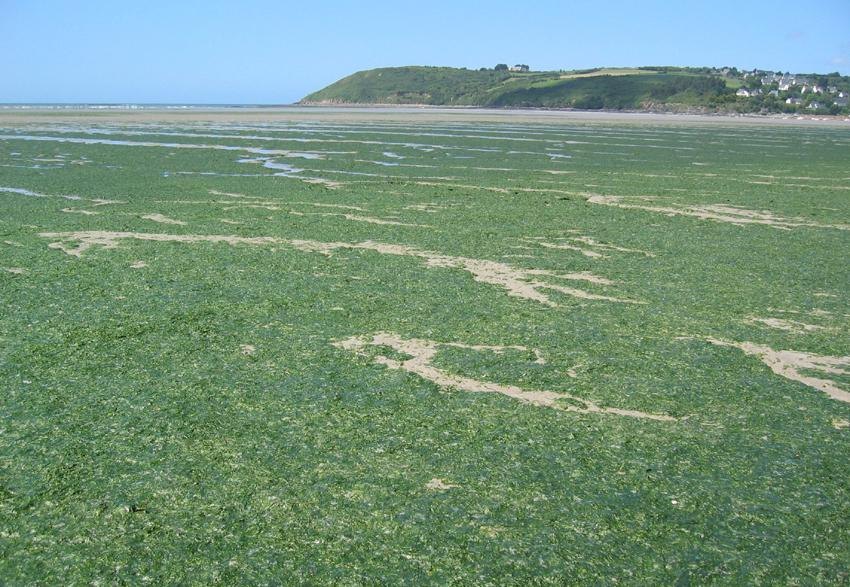
On the afternoon of July 28, 2009, 27-year-old virology researcher Vincent Petit was trying to lead his retired racehorse across a small stream flowing onto the beach at Saint-Michel-en-Grève on the coast of Brittany, France. The horse sank into the mud beneath a layer of green algae and suffocated within half a minute. As Petit struggled to free it, he collapsed. A mechanical excavator operated by a local seaweed-clearing company pulled him out of the mud.1
Gendarmerie officials initially claimed the horse had simply drowned in the mud. However, an autopsy requested by the owner revealed neither water nor mud in the lungs; the animal had died from sudden and widespread pulmonary edema.2 Two weeks later, the French state environmental risk agency INERIS measured the air at the exact same beach and detected 1,000 parts per million (ppm) of hydrogen sulfide.3
- How harmless seaweed in the ocean transforms on the sand within a few days.
- Whom a French court held responsible in 2025 for the death of a runner.
- The most common health complaints of people living along seaweed-impacted Caribbean shores.
- Where the brown accumulations on Mediterranean and Aegean beaches fit into this story.
What happens when seaweed rots on the sand?
Algae floating in the ocean is alive and releases nothing toxic into the air. Once waves cast it ashore, its cells begin to die, and bacteria invade the mass. Within the center of a thick pile, oxygen is quickly depleted. Bacteria thriving in this oxygen-free environment then consume sulfate from seawater, leaving hydrogen sulfide behind as a byproduct. This gas produces the characteristic rotten egg smell, accompanied by ammonia.
The toxicology team at the University Hospital of Martinique notes that stranded sargassum seaweed begins releasing massive quantities of both gases within 48 hours.4 Green algae in Brittany presents an additional trap. The top layer dries in the sun, forming a white crust beneath which the gas accumulates. A footstep or a hoof breaking this crust suddenly releases the trapped pocket.5 Because hydrogen sulfide is slightly heavier than air, it gathers in depressions, stream mouths, and wind-sheltered corners.
Human olfaction is unreliable in this scenario, which complicates safety. According to the US Agency for Toxic Substances and Disease Registry (ATSDR), some people detect the odor at concentrations as low as 0.0005 ppm. However, once the concentration exceeds 100 ppm, the olfactory nerve becomes paralyzed within 2 to 15 minutes, making it seem as though the odor has vanished precisely when the gas is most dangerous. Taking just a few breaths above 500 ppm is enough to cause immediate unconsciousness.6
Who was the runner in Hillion?
On September 8, 2016, 50-year-old Jean-René Auffray went for a run near the mouth of the Gouessant River in Hillion, located in the Bay of Saint-Brieuc, and was found dead face-down in the mud. An autopsy could only be performed 19 days later, the prosecutor's office closed the investigation in 2017, and the administrative court in Rennes dismissed the family's compensation claim in 2022.
On June 24, 2025, the Administrative Court of Appeal of Nantes overturned that ruling. According to the court, the sudden and generalized pulmonary edema that caused the man's death could only be explained by inhaling very high concentrations of hydrogen sulfide. Gas detectors deployed in the area weeks after the death saturated quickly. The court found the state 60 percent at fault for failing to enforce European and French regulations against agricultural nitrate pollution, ordering a total compensation payment of 332,843 euros to the family. The remaining 40 percent of fault was assigned to Auffray himself for deciding to run in an estuary known for its risks.7 This marked the first time a French court established a direct legal link between green algae and a human fatality.
What is the impact of months of exposure in the Caribbean?
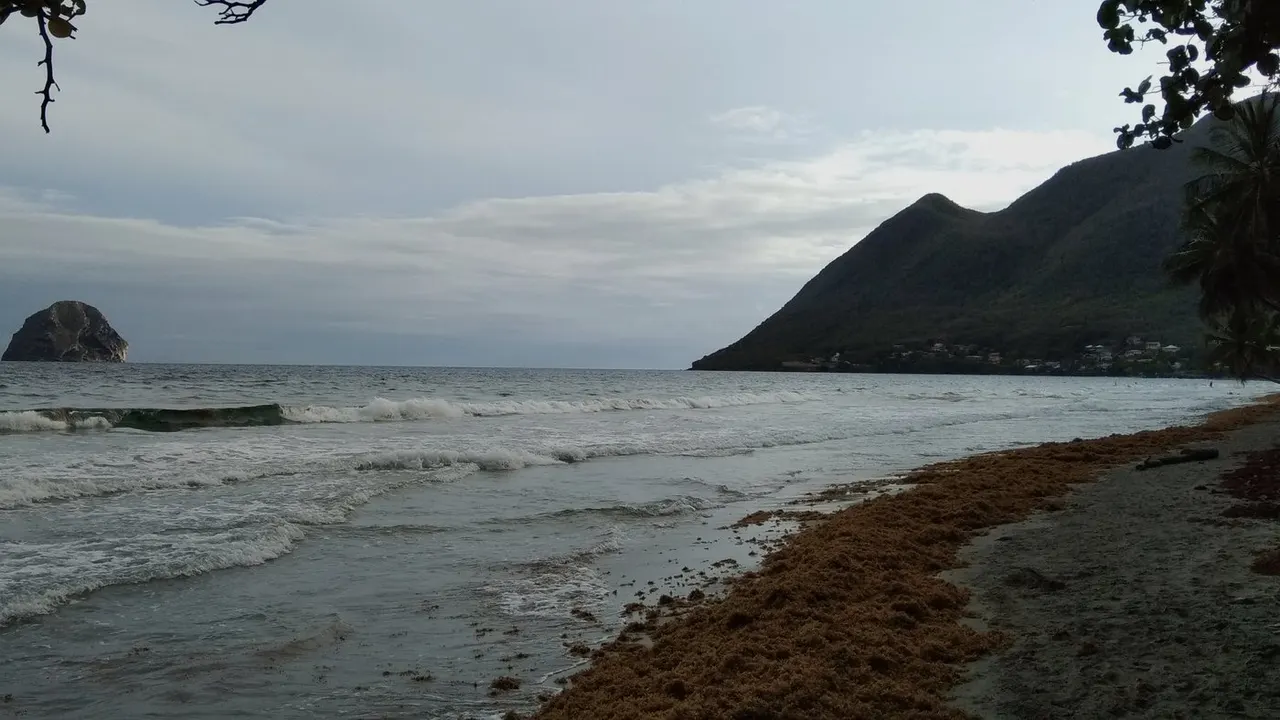
While the incidents in Brittany involved sudden, high-dose exposures, residents of coastal homes in the Caribbean experience months of low-dose inhalation. Since 2011, a massive sargassum belt has formed across the Atlantic, stretching from West Africa to the Gulf of Mexico. This belt surpassed 20 million tons in June 2018.8 Satellite measurements from the University of South Florida recorded a new record of 37.5 million tons in May 2025.9
The University Hospital of Martinique recorded 154 patients seeking medical care due to sargassum exposure throughout 2018. These patients had been breathing the affected air for an average of three months. Eighty percent presented with nervous system symptoms such as headaches and dizziness, 77 percent reported gastrointestinal issues like nausea and diarrhea, and 69 percent experienced shortness of breath and coughing. The neighborhoods where these patients lived matched the coastlines where seaweed accumulated most densely and sensors recorded the highest gas levels. The research team calculated that residents along these shores might breathe gas concentrations above 5 ppm for roughly 50 days a year.10
Consequently, the High Council for Public Health of France established tiered thresholds for the islands in 2018. If the 24-hour average gas concentration falls between 1 and 5 ppm, the public is advised to stay away from the seaweed accumulations. When levels exceed 5 ppm, only teams equipped with alarmed detectors are allowed onto the beach, and local authorities can temporarily close nearby public buildings such as schools and workplaces.11
Evidence regarding long-term health impacts remains less definitive. Medical records of 3,020 women who gave birth in Martinique between 2016 and 2020 revealed no statistically significant difference in the rate of preeclampsia between those living within two kilometers of the coast and those living further away (7.5 percent versus 6.1 percent). However, the onset of the condition occurred earlier among women living closer to the shore, averaging the 32nd week of pregnancy compared to the 35th week for those living inland.12 A sleep study involving 685 participants also showed that as average six-month gas levels rose, episodes of central sleep apnea—where the brain temporarily fails to signal breathing muscles—increased.13 Both investigations are observational studies, meaning they demonstrate correlations rather than proving direct causation.
What other toxins and bacteria are found in seaweed?
As sargassum absorbs phosphate from seawater, it co-extracts arsenic, accumulating the heavy metal within its tissues.14 Inorganic arsenic levels measured in sargassum washing up on the Mexican Caribbean coast ranged between 12.7 and 62.9 milligrams per kilogram, with an annual average of 41 milligrams. This figure far exceeds international safety limits established for food and animal feed, and surpasses the European Union's threshold of 40 milligrams permitted in fertilizers.15 Consequently, hauling seaweed collected from shores to use as garden fertilizer is not entirely benign.
Regarding microbiological risks, Florida Atlantic University sequenced the genomes of 16 Vibrio strains isolated from sargassum, plastic marine debris, and seawater in 2023, identifying genes associated with potential pathogenicity.16 However, the "flesh-eating bacteria" widely sensationalized in news reports were not found in these samples, nor has it been demonstrated that humans contract infections directly from seaweed contact.
What do brown seaweed accumulations mean on beaches?
Many of the brown, ribbon-like accumulations piling up along Mediterranean and Aegean shores after winter storms are not even algae. They consist of shed leaves of Posidonia oceanica, an endemic Mediterranean flowering seagrass. These accumulations dissipate wave energy and prevent sand erosion. In Sardinia, 106,180 cubic meters of seagrass leaves were mechanically removed from 44 beaches in 2004, and researchers subsequently measured that this clearing activity also stripped away valuable beach sand.17
The common thread in both the Caribbean and Brittany incidents is the prolonged unmanaged decomposition of thick, wet seaweed masses. Public health guidelines recommend avoiding the downwind side of decaying seaweed heaps when a rotten egg odor is present, and keeping infants, young children, pregnant women, and individuals with asthma or heart conditions far away. Animals are also at risk; in July 2008, two dogs died on an algae-covered beach in Hillion, with autopsies confirming acute pulmonary edema in both cases.2 In Martinique, the air quality agency Madininair continuously monitors hydrogen sulfide levels through sensors deployed along the coast, restricting beach access to detector-equipped response teams whenever the 24-hour average exceeds the 5 ppm threshold.
Notes and Sources
- Ganley, E. (August 2009). “Horse dies, France faces reality of toxic beaches.” Associated Press / Phys.org. phys.org. ↩
- “Algues vertes. L'autopsie du cheval renforce le soupçon.” Le Télégramme, August 2009. letelegramme.fr. ↩
- INERIS (August 19, 2009). Résultats de mesures ponctuelles des émissions d'hydrogène sulfuré et autres composés gazeux potentiellement toxiques issues de la fermentation d'algues vertes (ulves). Verneuil-en-Halatte. ↩
- Resiere, D. et al. (2021). “Effets sanitaires de la décomposition des algues sargasses échouées sur les rivages des Antilles françaises.” Toxicologie Analytique et Clinique 33(3). doi:10.1016/j.toxac.2021.05.003. ↩
- Haut Conseil de la santé publique (December 10, 2021). Algues vertes et sulfure d'hydrogène, notice. hcsp.fr. ↩
- ATSDR (2016). Toxicological Profile for Hydrogen Sulfide and Carbonyl Sulfide. US Department of Health and Human Services. atsdr.cdc.gov. ↩
- Cour administrative d'appel de Nantes, ruling of June 24, 2025; cited in: “Algues vertes en Bretagne : l'État reconnu responsable de la mort du joggeur survenue en 2016.” Ouest-France. ouest-france.fr. ↩
- Wang, M. et al. (2019). “The great Atlantic Sargassum belt.” Science 365(6448): 83-87. doi:10.1126/science.aaw7912. ↩
- University of South Florida Optical Oceanography Lab (May 31, 2025). Outlook of 2025 Sargassum blooms, May bulletin. optics.marine.usf.edu. Also: NASA Earth Observatory (2026). “Sizing Up the Sargassum Belt.” ↩
- Resiere, D., Mehdaoui, H., Florentin, J. et al. (2021). “Sargassum seaweed health menace in the Caribbean: clinical characteristics of a population exposed to hydrogen sulfide during the 2018 massive stranding.” Clinical Toxicology 59(3): 215-223. doi:10.1080/15563650.2020.1789162. ↩
- Haut Conseil de la santé publique (June 8, 2018). Advisory opinion on management measures regarding the exposure of West Indian populations to ammonia (NH3) and hydrogen sulfide (H2S) from the decomposition of sargassum algae. ars.sante.fr. ↩
- Bahezre de Lanlay, D., Monthieux, A., Banydeen, R. et al. (2022). “Risk of preeclampsia among women living in coastal areas impacted by sargassum strandings on the French Caribbean island of Martinique.” Environmental Toxicology and Pharmacology. PubMed 35671953. ↩
- Banydeen, R., Rejaudry Lacavalerie, M., Florentin, J. et al. (2024). “Central sleep apnea and exposure to ambient hydrogen sulfide emissions from massive strandings of decomposing sargassum in the Caribbean.” Science of the Total Environment 912: 168886. doi:10.1016/j.scitotenv.2023.168886. ↩
- Devault, D. A., Pierre, R., Marfaing, H., Dolique, F., and Lopez, P. J. (2021). “Sargassum contamination and consequences for downstream uses: a review.” Journal of Applied Phycology 33: 567-602. doi:10.1007/s10811-020-02250-w. ↩
- Ortega-Flores, P. A. et al. (2023). “Inorganic arsenic in holopelagic Sargassum spp. stranded in the Mexican Caribbean: seasonal variations and comparison with international regulations and guidelines.” Aquatic Botany. doi:10.1016/j.aquabot.2023.103674. ↩
- Mincer, T. J. et al. (2023). “Sargasso Sea Vibrio bacteria: underexplored potential pathovars in a perturbed habitat.” Water Research. sciencedirect.com. ↩
- “Posidonia oceanica ‘banquette’ removal: environmental impact and management implications.” (2006). Sardinia coastal study. academia.edu. ↩
This article is for informational purposes only and does not constitute medical advice. Cover: Sargassum washed ashore on Le Diamant beach, Martinique. Photo: Patrice78500, CC BY-SA 4.0, Wikimedia Commons.