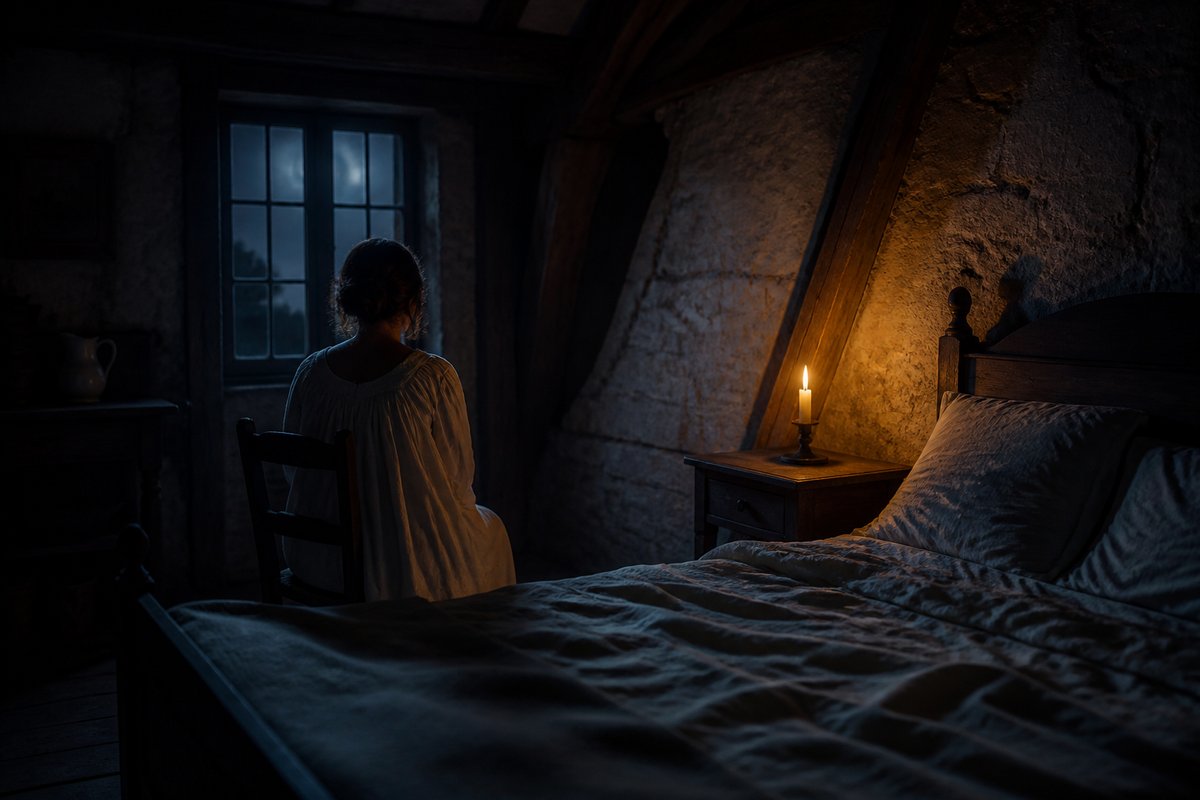
On the night of April 13, 1699, in a village in northern England, nine-year-old Jane Rowth and her mother awoke from their slumber. Shortly afterward, several men arrived at the door, the mother left with them and never returned, and her body was discovered days later in an unsolved murder case. When Jane testified in court about that night, she mentioned that she and her mother had risen from their "first sleep" before the men arrived, speaking of it as a matter-of-fact occurrence requiring no explanation.
Nearly 300 years later, in the early 1990s, historian Roger Ekirch encountered this phrase while reading state archives in London. If there was a first sleep, a second sleep logically had to follow. In the months that followed, he discovered the same expression in numerous other court records. By the publication of his book in 2005, Ekirch had gathered over 500 references, a list that now exceeds 2,000 entries.1
- Court records and historical documents from pre-industrial Europe demonstrate that the night was divided into two distinct sleep periods.
- A 1990s laboratory experiment involving 14 hours of daily darkness independently confirmed historical findings on human sleep patterns.
- The modern habit of eight continuous hours of sleep is a relatively recent phenomenon established during the Industrial Revolution.
- Waking up during the night is often a normal physiological response rather than a medical disorder, provided total sleep duration remains sufficient.
What is the history of first and second sleep?
When Virginia Tech professor Roger Ekirch published his findings in 2001, the historical picture was clear: pre-industrial sleep in Europe was distinctly biphasic.1 People retired to bed shortly after dusk, woke up naturally around midnight, remained awake for an hour or two, and then drifted into a second sleep that lasted until morning. This period of nocturnal wakefulness was not wasted time. Individuals tended the hearth, checked on livestock, prayed, reflected on dreams, or even visited neighbors. Sixteenth-century French physician Laurent Joubert went so far as to write that the most fertile time for couples was after the first sleep.
Furthermore, this sleep pattern was not restricted to Europe. Ekirch notes that pre-industrial societies isolated from electricity, such as the Tiv people of Nigeria, maintain distinct terms for the first and second sleeps. The historical traces extend even further back into antiquity, with references to the "first sleep" appearing in Homer's Odyssey and Virgil's Aeneid. Consequently, for a significant portion of human history across millennia, the night was experienced as divided rather than monolithic.
How did laboratory experiments confirm biphasic sleep?
While Ekirch was examining historical records in archives, psychiatrist Thomas Wehr was investigating a completely different question at the National Institute of Mental Health in the United States: what did human sleep look like during pre-industrial winter nights? Wehr placed 15 healthy male volunteers on a schedule where they received only 10 hours of light and 14 hours of darkness per day for several weeks. Within a few weeks, the subjects' sleep patterns spontaneously divided into two symmetric bouts of sleep separated by one to three hours of quiet wakefulness.2 None of the participants had been instructed about segmented sleep; their bodies simply reverted to the historical pattern when provided with sufficient darkness.
In a 1992 paper, Wehr demonstrated that measurements of the hormone melatonin also shifted, as the internal biological clock readjusted to the length of the night. After reading about this experiment in The New York Times in 1995, Ekirch contacted Wehr, discovering that their independent conclusions perfectly aligned. Wehr's observation remains widely cited today: experiencing a period of wakefulness during the night is not necessarily a sleep disorder, but rather a natural pattern that reemerges when freed from artificial environments.
Who invented the modern eight-hour sleep schedule?
The modern ideal of eight continuous hours of sleep emerged during the 19th century, a transition meticulously tracked by Ekirch. The introduction of gas lamps and subsequently electric lighting transformed the evening into usable time, prompting people to stay awake later. Simultaneously, factory labor standardized morning schedules. As the night was compressed by social demands, the two sleep periods merged into a single block, erasing the memory of segmented sleep within just a couple of generations. Ekirch notes that he was able to trace this transition decade by decade through contemporary newspapers and medical texts.1 Compared to thousands of years of ancestral habit, consolidated sleep is an invention barely two centuries old, roughly contemporary with the steam locomotive.
Consequently, waking up in the middle of the night and struggling to return to sleep immediately is not always a sign of pathology. Sleep researchers suggest that simply understanding this history can alleviate distress for those troubled by nocturnal awakenings, as the primary disruption is often the panic of not sleeping rather than the waking itself.
Does historical sleep justify chronic sleep deprivation?
Recognizing the historical flexibility of sleep does not validate the demanding schedules praised in modern corporate culture. Although Wehr's subjects divided their sleep into two segments, their total nightly sleep duration still exceeded eight hours; the structure of sleep changed, but the total duration did not. When total sleep time is restricted, health outcomes deteriorate. A meta-analysis combining 16 prospective studies with over 1.3 million participants found that short sleep duration is associated with a 12 percent higher risk of all-cause mortality compared to sleeping 7 to 8 hours.3 Chronic short sleep is also consistently linked to cardiovascular disease, type 2 diabetes, and obesity. Historical records demonstrate that sleep can be divided, but they provide no evidence that shortening total sleep time is harmless.
What should you do if you wake up at night?
When waking up at three in the morning, the primary rule is to avoid panic. Calculating the remaining hours until morning and worrying about the upcoming day increases physiological arousal and delays the return to sleep. The second rule is to avoid checking the clock, as monitoring time initiates mental calculations and stress that hinder sleep onset. Checking a smartphone is even more detrimental, as it combines time-checking, bright light exposure, and mental stimulation. The third rule is to keep lighting dim. If getting out of bed is necessary, use low-intensity, warm-colored lighting, because bright white light signals the internal clock that morning has arrived. If tossing and turning in bed exceeds twenty minutes, getting up to engage in a calm, mundane activity in dim light until sleepiness returns is recommended—precisely the behavior practiced by individuals in historical archives who simply did not label it as insomnia.
If nighttime awakenings are persistent, impair daytime functioning, or are accompanied by symptoms like snoring and breathing pauses, medical consultation is required, as the history of biphasic sleep does not explain conditions such as sleep apnea. However, experiencing occasional midnight awakenings does not indicate a medical malfunction. Wehr's 1992 short-photoperiod experiment induced segmented sleep in participants, just as Ekirch documented historical references to the first and second sleeps in English-language sources published in 2001.
Notes and Sources
- Ekirch, A. R. (2001). "Sleep We Have Lost: Pre-industrial Slumber in the British Isles". The American Historical Review, 106(2), 343-386; Ekirch, A. R. (2005). At Day's Close: Night in Times Past. W.W. Norton.
- Wehr, T. A. (1992). "In short photoperiods, human sleep is biphasic". Journal of Sleep Research, 1(2), 103-107.
- Cappuccio, F. P., D'Elia, L., Strazzullo, P., Miller, M. A. (2010). "Sleep duration and all-cause mortality: a systematic review and meta-analysis of prospective studies". Sleep, 33(5), 585-592.