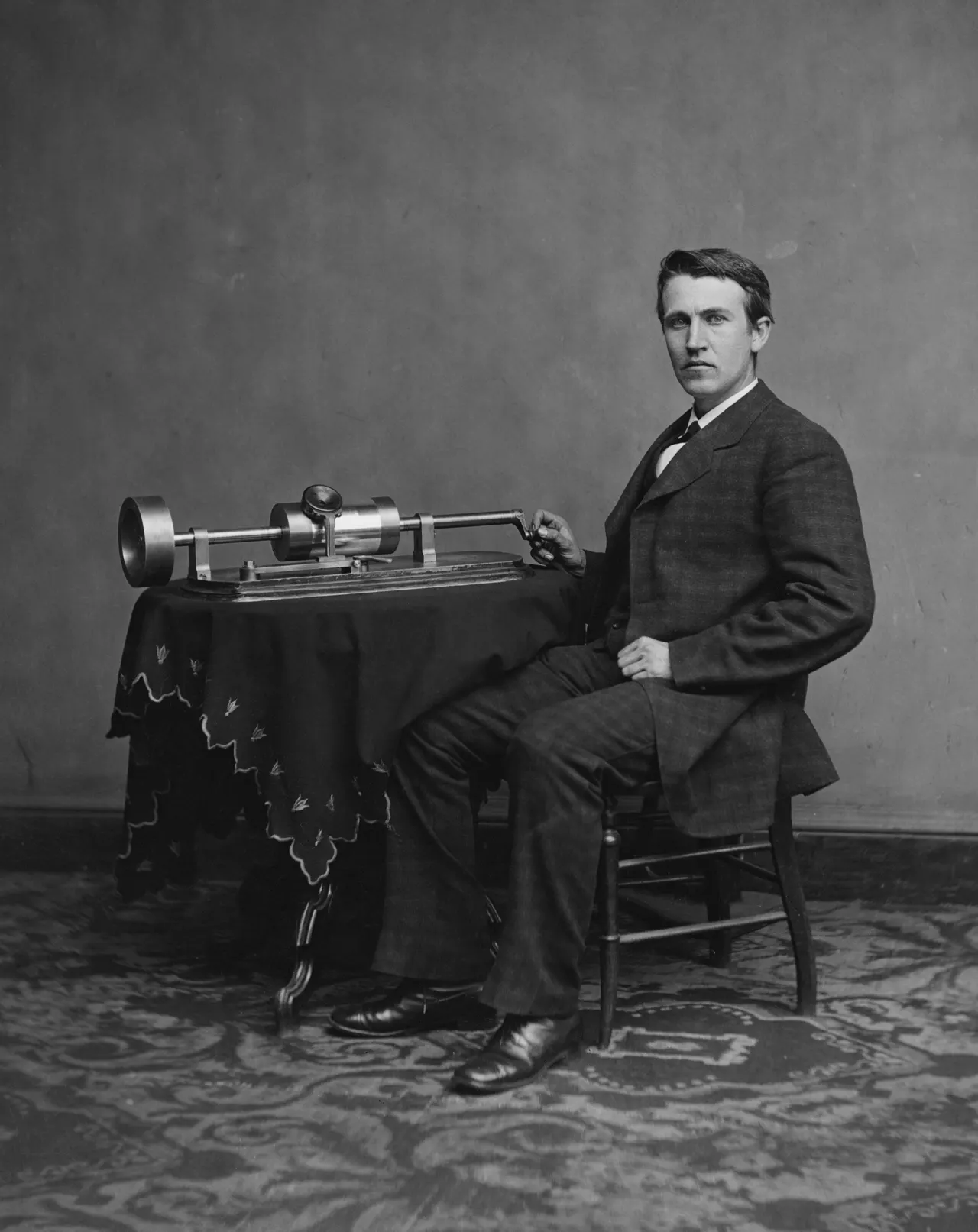
On November 21, 1877, Thomas Edison announced his invention of the phonograph, a revolutionary device that could mechanically record and reproduce sound. Working in his laboratory, Edison developed a system where sound vibrations moved a stylus to engrave physical deviations into a rotating cylinder. This announcement marked the birth of the recorded sound industry and changed the way humanity experiences music and speech. The phonograph was the first example of home audio technology, allowing individuals to preserve and replay voices and melodies for the first time in history.
How did sound become a physical object?
The journey toward the phonograph began not with the intent to listen, but with the desire to see. In 1857, Frenchman Édouard-Léon Scott de Martinville invented the phonautograph, which used a membrane and a boar’s bristle to scratch visual representations of sound waves onto glass coated in lampblack. While Scott successfully recorded the song "Au Clair de la Lune" in 1860, he never intended for these recordings to be heard; he viewed them as "sound writing" to be read by the human eye. It was Thomas Edison who made the conceptual and mechanical leap from merely visualizing vibrations to physically reversing the process to recreate the original sound.
In 1860, Édouard-Léon Scott de Martinville recorded the earliest known surviving sound of a human voice, though he lacked the technology to ever play it back.
Thomas Edison’s phonograph worked on the principle of mechanical and analogue reproduction. Sound waves entered a flaring horn or mouthpiece, striking a diaphragm that vibrated a stylus. This stylus then embossed or incised those vibrations into a rotating cylinder—initially wrapped in tinfoil. To hear the recording, the process was simply reversed: a playback stylus traced the grooves, vibrating the diaphragm and pushing the sound back out through the horn. This elegant mechanical solution turned the intangible nature of speech into a tangible, helical groove.

What distinguished Edison’s machine from its competitors?
While Thomas Edison held the primary patent for the phonograph, the late 19th century was a period of rapid refinement and fierce competition. In the 1880s, Alexander Graham Bell’s Volta Laboratory introduced the graphophone, which improved upon Edison’s design by using wax-coated cardboard cylinders and a cutting stylus that moved side-to-side. These wax cylinders provided a more durable and clearer medium than Edison’s original tinfoil. Despite these challenges, Edison remained the central figure of the industry, eventually registering 1,093 patents in the United States over his prolific career.
The competition shifted again in the 1890s when Emile Berliner introduced the gramophone. Unlike the phonograph’s cylinders, Berliner’s machine utilized flat discs with a spiral groove running from the outer edge toward the center. This transition from cylinders to discs was a pivotal moment in media history, as discs were far easier to mass-produce and store. While Edison’s original 1877 patent actually included the potential use of discs, it was Berliner who popularized the format that would dominate the 20th century. In British English, the term "gramophone" became the generic standard for disc players, while "phonograph" remained the preferred term in the United States for Edison’s specific technology.

How did the phonograph change the way people lived?
Before the phonograph, music was a live experience that required the physical presence of a performer. Edison’s invention brought the concert hall into the living room, making the phonograph the first piece of home audio equipment. By the early 20th century, families could purchase records and listen to world-class performances at their convenience. This democratization of culture was unprecedented, allowing people across different social classes and geographies to share the same auditory experiences. The phonograph became the centerpiece of the modern home, a status it maintained for decades.
The term phonograph is derived from the Greek words phōnē, meaning sound or voice, and graphē, meaning writing.
The impact of the phonograph extended into the scientific realm as well. In Australia, the device was first demonstrated on June 14, 1878, to the Royal Society of Victoria. The Society's Honorary Secretary, Alex Sutherland, utilized the machine to study linguistics, publishing a paper titled "The Sounds of the Consonants, as Indicated by the Phonograph." This demonstrated that Edison’s invention was not merely a toy or a music box, but a sophisticated tool for the study of acoustics and human speech, providing a level of precision that had been impossible for previous generations of scientists.

What is the legacy of the phonograph in the digital age?
The record-playing technology initiated by Thomas Edison in 1877 remained the dominant format for audio distribution for most of the 20th century. Even as high-fidelity electronics evolved, the core principle of a stylus tracing a groove remained the same. It was only in the 1960s with 8-track cartridges and cassette tapes, and later in the 1980s with the rise of the compact disc, that the phonograph’s dominance began to wane. The mechanical era of sound was largely superseded by digital formats that prioritized portability and durability over physical grooves.
However, the phonograph has proven remarkably resilient. Since the late 2000s, there has been a significant revival in vinyl records and turntables. Modern audiophiles often distinguish between a "record player," which is a self-contained unit with speakers, and a "turntable," a precision component used in high-end sound systems or DJ setups. In the hands of a DJ, a turntable becomes a "deck," used as a musical instrument in its own right. This modern appreciation for the analogue experience proves that Edison’s 1877 breakthrough still resonates, offering a physical connection to sound that digital files cannot replicate.

Today, as we look back at that November day in 1877, we recognize the phonograph as the ancestor of every record player, tape deck, and streaming service we use today. Thomas Edison did more than just invent a machine; he captured the human voice and gave it the power of immortality. The "sound writing" that began as scratches in lampblack and tinfoil has become the soundtrack of modern civilization, ensuring that no song or speech is ever truly lost to time.
Did you know? Thomas Edison’s original tinfoil phonograph was so novel that many people initially suspected he was a ventriloquist practicing a clever deception.
Did you know? The term "gramophone" was originally a proprietary trademark, but a 1910 English court ruling declared it a generic term that anyone could use.
Watch: Meet Edison's Tinfoil Phonograph from 1877
From the National Museum of American History channel.
Sources and further reading: Wikipedia — Phonograph, Thomas Edison (CC BY-SA). Images: Wikimedia Commons.