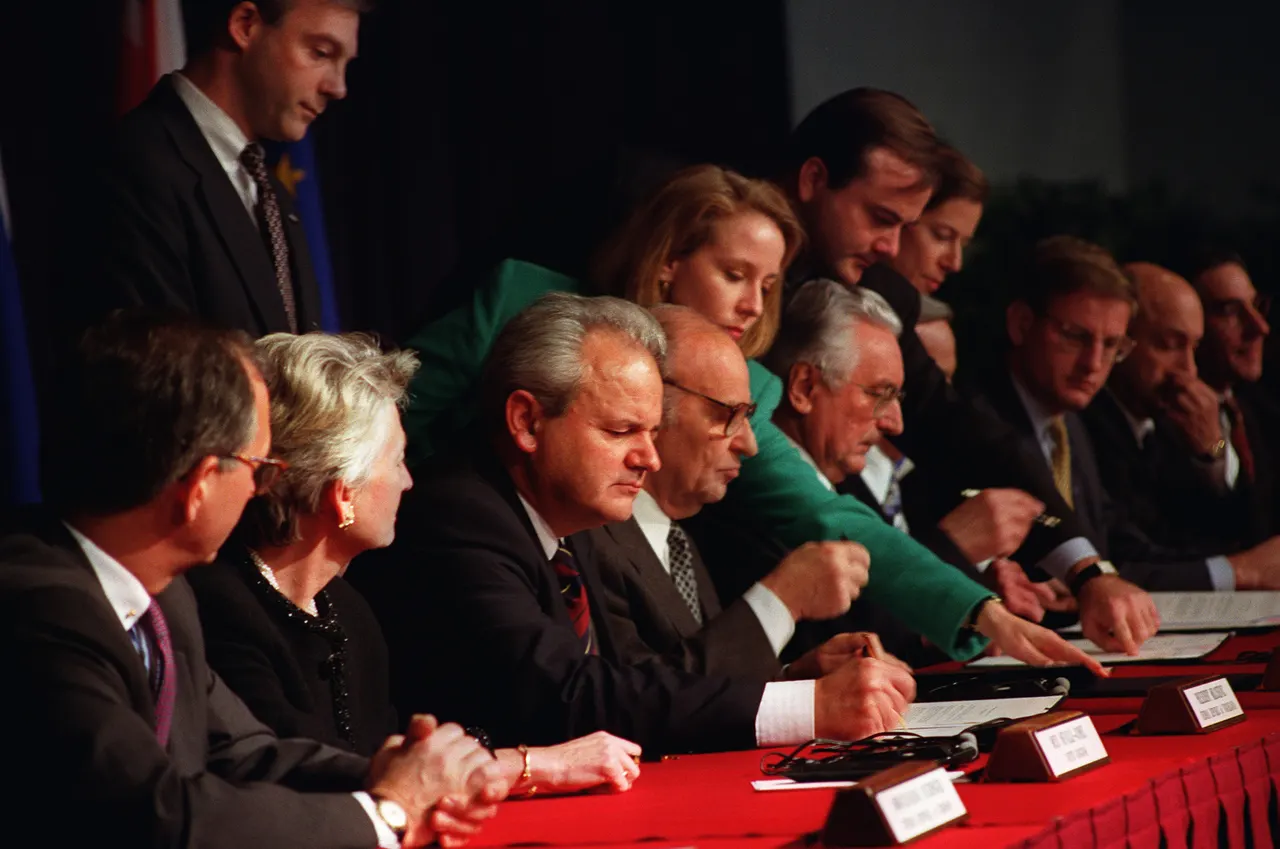
On November 21, 1995, leaders representing the warring factions of the Bosnian War gathered at Wright-Patterson Air Force Base near Dayton, Ohio, to initial the General Framework Agreement for Peace in Bosnia and Herzegovina. This historic act brought a conclusion to three and a half years of brutal conflict that had torn the region apart as part of the broader Yugoslav Wars. By mandating a sovereign, unified state comprising two distinct entities, the agreement provided a roadmap to stabilize a fractured nation and end the violence that had plagued the Balkan Peninsula.
Why was an air force base in Ohio chosen for the talks?
The choice of Wright-Patterson Air Force Base as the venue was a deliberate tactical decision by the United States-led mediation team, headed by Assistant Secretary of State Richard Holbrooke. Diplomats sought a remote, secure location that would remove the key participants—Slobodan Milošević, Franjo Tuđman, and Alija Izetbegović—from their traditional political spheres of influence. By isolating the parties at this Ohio facility, the international mediators successfully stripped away the ability for the leaders to posture through the media, forcing them to engage in the intense, focused negotiations necessary to secure a lasting peace.
Who were the key architects of the accord?
The negotiations were the culmination of extensive shuttle diplomacy conducted by the United States, with support from the Contact Group, which included Russia and European powers. While Richard Holbrooke managed the grueling face-to-face sessions, he was supported by a multinational team including US Secretary of State Warren Christopher, EU Special Representative Carl Bildt, and Russian First Deputy Foreign Minister Igor Ivanov. These diplomats faced the immense task of reconciling the divergent interests of the Serb, Croat, and Bosniak populations, often battling against deep-seated mistrust that had fueled years of warfare.

The Dayton Agreement mandates that Bosnia and Herzegovina exists as a single, sovereign state composed of two parts: the largely Serb-populated Republika Srpska and the mainly Croat-Bosniak-populated Federation of Bosnia and Herzegovina.
The participants finalized the agreement after three weeks of intense confinement, from November 1 to November 21, 1995. The resulting document, which was later ceremonially signed in Paris on December 14, 1995, outlined the specific political structures of the new state, including a central government, a rotating presidency, and a constitutional court. This structure was designed to balance the needs of a decentralised state while ensuring that no single entity could unilaterally secede from the sovereign republic of Bosnia and Herzegovina.
How did the agreement reshape the geography of the conflict?
Prior to the signing of the Dayton Agreement, territorial control in Bosnia and Herzegovina was fragmented, with Bosnian Serbs holding 46% of the territory, Bosniaks controlling 28%, and Bosnian Croats holding 25%. The agreement introduced the Inter-Entity Boundary Line, a critical demarcation that required significant territorial concessions. Bosnian Serbs were required to surrender key positions in Sarajevo and eastern regions while gaining other mountainous tracts, a trade-off intended to reflect a more equitable division of the nation.

Implementation of the agreement was not left to chance; a wide range of international organizations were tasked with ensuring compliance. The NATO-led Implementation Force, or IFOR, took over from the United Nations forces to oversee the military aspects of the peace, while the Office of the High Representative was established to manage civil implementation. Furthermore, the Organization for Security and Co-operation in Europe was assigned the monumental duty of organizing the first post-war free elections in 1996.
Despite the achievement of silencing the guns, the Dayton Agreement has faced significant criticism in the years since its inception. Detractors argue that the governance system it created is unduly complex and, in some ways, has served to entrench the divisions and ethnic cleansing that occurred during the war. Legal challenges have occasionally been brought before the Constitutional Court of Bosnia and Herzegovina, questioning the document's structure, yet the Court has consistently upheld the Agreement as the foundational law of the modern state.

The legacy of the Dayton Agreement remains a subject of study and debate, viewed by many as a vital instrument that prevented further bloodshed, while simultaneously acting as an ongoing political challenge for those living within its framework. As a testament to the fragile nature of post-conflict reconstruction, the agreement persists as the primary document governing the sovereignty and unity of Bosnia and Herzegovina today.
The Dayton Agreement was formally witnessed by global leaders including Bill Clinton, Jacques Chirac, and Helmut Kohl during a ceremonial signing in Paris.

The negotiations in Ohio involved over 800 staff and attendants, effectively creating a temporary city to facilitate the peace process.
The Constitutional Court of Bosnia and Herzegovina affirmed that it lacks the authority to evaluate the constitutionality of the Dayton Agreement because the constitution itself exists as an annex of that very document.
Watch: The Dayton Peace Accords (1995): Ending the War in Bosnia
From the History Moments channel.
Sources and further reading: Wikipedia — Dayton Agreement, Wright-Patterson Air Force Base, Dayton, Ohio, Bosnia and Herzegovina (CC BY-SA). Images: Wikimedia Commons.