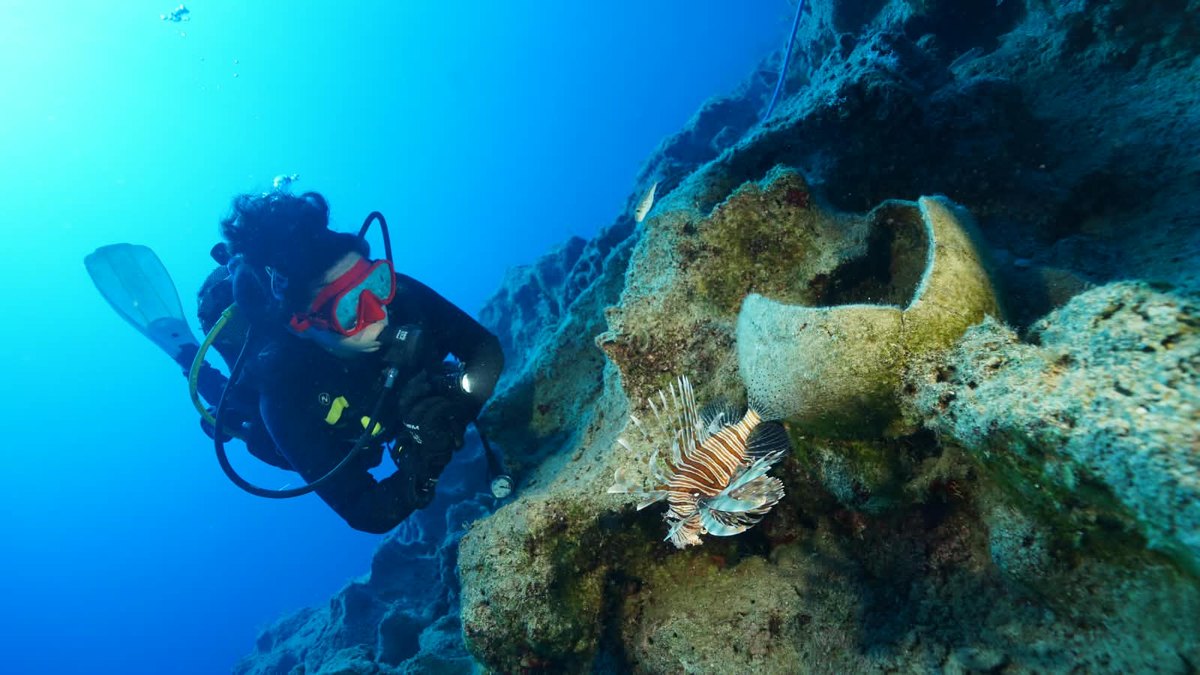
A 4,700-year-old cargo of clay jars submerged off the coast of Kekova Island in southern Turkey may belong to the world's oldest known shipwreck, according to Turkish authorities and marine archaeologists. Lying on a rocky slope 30 meters beneath the surface, the discovery includes perfectly preserved ceramic vessels that coincide with the era of Egypt's Great Pyramids, even though the vessel's wooden hull has long since decayed.
During the 2026 excavation season, divers carefully transferred the ancient vessels into crates to bring them to the surface. Archaeologist Karin Sowada of Australia's Macquarie University examined one of the jars and identified a dark, lustrous residue preserved inside. Speaking to the BBC, she recalled being overwhelmed by the sight of organic matter remaining intact after nearly five millennia.1
On October 14, 2026, Turkish Minister of Culture and Tourism Mehmet Nuri Ersoy announced that the amphorae date to the Early Bronze Age, between 4,400 and 4,700 years ago, declaring the site to be the oldest shipwreck ever discovered. The ongoing excavation is directed by the Antalya Museum Directorate, with scientific direction led by Associate Professor Hakan Öniz of Akdeniz University.2 If the timeline holds, the vessel sank at roughly the same time the Pyramids of Giza were being constructed.
How Was the Age of the Kekova Shipwreck Determined Without Wood?
Archaeologists determined the age of the Kekova shipwreck by comparing the specific shape and decorative features of the clay jars to well-dated Early Bronze Age ceramics. Radiocarbon dating typically relies on organic samples such as timber, seeds, or bone, none of which survived the oxygenated waters on the seabed. Instead, Hakan Öniz explained that the vessels feature two side handles, a raised ridge along the center of the body, and a flat base—a typological match for ceramics from Egypt and the Near East dated to between 4,400 and 4,700 years ago.1 Similar amphorae have previously been documented near the pyramids of Giza, Saqqara, and Abusir, as well as at Troy and Crete.2
Initial surveys of the site began in 2024 during a marine archaology expedition conducted by Akdeniz University around Kekova. Researchers mapped the seabed slope, where sand mixes with rocky outcrops, and created orthophotographs of the scattered debris field. Single amphorae were recovered in 2024 and 2025 for close study, leading to a preliminary report by Öniz and C. Öztosun in the Journal of Maritime Archaeology.3
Full-scale underwater excavations commenced in 2026. The team informed the BBC that the wreck field contains more than 30 amphorae along with three large stone anchors. Based on the distribution of the cargo, researchers estimate that the ship was a merchant vessel approximately 10 meters in length.1 No wooden structural remains have been preserved.
Where Did the Kekova Shipwreck Cargo Originate?
Clay composition analysis indicates that the jars recovered from the Kekova site were almost certainly manufactured in workshops located in the Jordan Valley. Based on these petrographic and chemical signatures, the research team suggests the merchant vessel loaded its cargo at a port along the Levantine coast before sailing west toward regional trade hubs such as Troy or Crete.2
The vessel's anchors support a Levantine connection. The preliminary report describes two stone anchors with three perforations that resemble Bronze Age finds from Minoan Crete, Cyprus, Anatolia, and the Levant. A third anchor featuring a single hole matches designs common to the Anatolian and Levantine coastlines.3
What Do the Recovered Artifacts Reveal About Life on Board?
Among the items recovered from the Kekova site is a unique ceramic vessel featuring nine distinct engraved markings and two holes through its body. Ministry officials suggest the object may have served as a churn for producing cheese or butter, raising the possibility that Bronze Age sailors kept livestock such as goats aboard the vessel for milk during long voyages.2 The preliminary report notes that this artifact differs significantly from the other amphorae in fabric, manufacturing technique, and purpose, with no matching parallel found elsewhere at the site.3 Content analysis has not yet been completed to verify the churn hypothesis.
Dark residues extracted from the interior of other storage vessels are currently undergoing laboratory testing. According to Sowada, the substances could prove to be olive oil, wine, or tree resin. She noted that large ceramic containers were routinely reused for decades at destination ports, meaning the preserved organic residue may reflect a previous shipment rather than the vessel's final cargo.1
Notes and Sources
- Francis, A., Morelle, R., & Church, K. (October 14, 2026). "World's oldest shipwreck found off Kekova Island in Turkey". BBC News. Statements by Hakan Öniz and Karin Sowada. bbc.com ↩
- Ministry of Culture and Tourism of Turkey press release and statement by Minister Mehmet Nuri Ersoy, October 14, 2026. Reported by Demirören News Agency / CNN Türk, "Bakan Ersoy: Dünyanın en eski batığının izlerini gün yüzüne çıkarıyoruz", October 14, 2026. Also Akdeniz University press release, October 15, 2026. akdeniz.edu.tr ↩
- Öniz, H., & Öztosun, C. (2026). Preliminary Report on the Early Bronze Age Shipwreck in the Kekova Region of Antalya. Journal of Maritime Archaeology, 21(3). doi:10.1007/s11457-026-09532-3 ↩
- Yuhas, A. (October 16, 2026). "The World's Oldest Shipwreck? Maybe, but 'We're All Excited by Maybe.'" The New York Times. Commentary by Justin Leidwanger and Sean Kingsley. nytimes.com ↩
- Hellenic Institute of Marine Archaeology (HIMA). Excavation of the Early Helladic Dokos Shipwreck, 1989-1992. Enalia Annual 2 (1990, published 1992). Athens: HIMA. ↩
- Bass, G. F. (1967). Cape Gelidonya: A Bronze Age Shipwreck. Transactions of the American Philosophical Society, 57(8). Philadelphia. ↩
- Pulak, C. (1998). The Uluburun shipwreck: an overview. International Journal of Nautical Archaeology, 27(3), 188-224. doi:10.1111/j.1095-9270.1998.tb00803.x ↩
- Images: Cover, numbered amphora on underwater slope with excavation diver; pre-excavation amphora and recovery crate. Photos courtesy of Akdeniz University press release, Ministry of Culture and Tourism of Turkey excavation. Map and chronology graphic derived from sources 2, 3, 5, 6, and 7; map data from Natural Earth. ↩