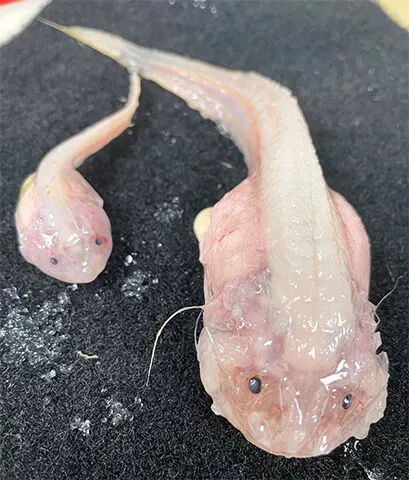
On August 15, 2022, researchers lowered a baited camera into the Izu-Ogasawara Trench off the coast of Japan. At a depth of 8,336 meters, a juvenile snailfish appeared on screen, marking the deepest observation of a fish ever recorded. Five days later, during the same expedition, two additional snailfish were captured at 8,022 meters in the neighboring Japan Trench, remaining the deepest fish ever physically collected.
Alan Jamieson, a marine biologist at the University of Western Australia who led the expedition, had previously calculated with his colleagues in 2014 that the physiological limit for fish was approximately 8,200 meters. The linchpin of this calculation was trimethylamine N-oxide, or TMAO, a small molecule that accumulates in the muscle tissue of marine fish. This molecule also serves as the primary precursor to the pungent odor released when cooking fish.
What does this article cover?
- The fish filmed at 8,336 meters was swimming just beyond the theoretical limit defined in 2014.
- Fresh marine fish contain high levels of TMAO, but they do not possess a fishy smell until decomposition begins.
- Microwave ovens can create temperature variations exceeding 100 degrees within a single piece of food.
- Adding lemon to fish is a chemical necessity, serving a function similar to how the human liver processes waste.
Why does fresh marine fish not smell like fish?
Seawater is highly saline, making the body fluids of bony fish relatively dilute by comparison. To prevent water from being drawn out of their tissues, fish accumulate small molecules in their muscles, primarily TMAO. According to the Food and Agriculture Organization (FAO), marine fish muscles contain TMAO concentrations ranging from 1 to 5 percent of the dehydrated tissue weight, a molecule nearly absent in freshwater fish and terrestrial animals.
TMAO itself is effectively odorless. The characteristic fishy smell is produced by bacteria, such as Shewanella putrefaciens, that multiply on the surface of the meat after the fish dies. As oxygen levels deplete, these bacteria use TMAO in their respiration process, releasing trimethylamine (TMA) as a byproduct. TMA has a boiling point of 2.87 °C and exists as a gas at room temperature. The human nose can detect it at concentrations as low as 2 molecules for every 10 billion molecules in the air.
FAO tasting studies suggest that ice-stored fish is typically rejected once TMA nitrogen levels reach 10 to 15 milligrams per 100 grams of flesh. The longer a fish sits on a market counter or in a refrigerator, the higher the load of TMA it carries into the oven.
How does TMAO define the 8,200-meter depth limit?
Beyond its culinary fame, TMAO plays a critical role in pressure resistance. As water pressure increases with depth, it destabilizes the folded structure of proteins; TMAO helps maintain these proteins in equilibrium. A research team led by biologist Paul Yancey at Whitman College compiled data showing that muscle TMAO levels in bony fish increase from 40 millimoles per kilogram at the surface to 261 millimoles at 4,850 meters. The team captured five snailfish at 7,000 meters in the Kermadec Trench, where they measured a record 386 millimoles.
As TMAO accumulates, the internal fluid of the fish becomes more concentrated. In shallow-water bony fish, this density is approximately 350 milliosmoles per kilogram, compared to 1,100 in seawater. The Kermadec snailfish reached 991. When Yancey’s team extrapolated these measurements, the point at which the internal fluid reaches osmotic equilibrium with seawater falls at approximately 8,200 meters. According to the team, this represents a physiological limit for bony fish. When the paper was published, the deepest quarter of the ocean, ranging from 8,400 to 11,000 meters, remained entirely devoid of fish observations.
In a 2023 statement to the Guinness World Records, Jamieson described the limit as a band between 8,200 and 8,400 meters. He noted that because temperature—like pressure—stresses proteins, fish can descend slightly deeper in warmer waters, explaining why records are often found off the coast of Japan, where trenches are both deep and relatively warmer.
Why does microwave cooking intensify fishy odors?
Heating fish introduces a second source of odor: fat. Omega-3 fatty acids found in oily fish such as mackerel or sardines break down under heat and oxygen, releasing small aldehydes that disperse easily into the air. FAO guidelines note that pelagic fish like sardines and mackerel have the lowest TMAO levels, suggesting that the smell in these species is largely driven by fats. In 2004, a team led by Charlotte Jacobsen at the Technical University of Denmark identified 60 volatile components in milk enriched with fish oil; none smelled like fish individually, but the odor emerged only when several were combined.
Microwave ovens accelerate these reactions and distribute heat unevenly. A 2009 study by Annamalai Manickavasagan and Digvir Jayas at the University of Manitoba found that the temperature difference between the hottest and coldest spots in microwaved chicken pies varied between 31.6 and 130.5 °C. Because fish flesh is high in water and salt, it absorbs microwave energy efficiently. Hot spots can reach the temperature required to break down fats before the rest of the meal is warm, releasing volatile components in the process.
What is the chemistry behind lemon and fish?
TMA is a base. When it encounters an acid, it captures a proton to become a charged salt, preventing it from vaporizing. Because its pKa value is 9.8, more than 99 percent of TMA remains in this odorless, salt form when the pH of the environment falls below 7.8. This is the chemical rationale for the common practice of serving fish with lemon juice.
This reaction can also be observed visually. In 1862, the chemist Wicke observed that a glass rod coated with hydrochloric acid created a fog when held near a plant known for its fishy odor. Atmospheric scientists Jörg Sintermann and Albrecht Neftel suggested in 2015 that this fog was likely TMA reacting with acid to form small salt particles. Wicke also recorded that hawthorn and pear blossoms contain TMA, which these plants use to attract pollinators.

The human body also manages TMA daily. Gut bacteria produce TMA from choline and TMAO found in eggs, liver, and seafood. The enzyme FMO3 in the liver converts it back into odorless TMAO, which is then excreted in urine. Individuals with a hereditary deficiency in this enzyme may excrete TMA through sweat, breath, and urine. The first medical case was reported in The Lancet in 1970, involving a six-year-old girl whose mother noticed she occasionally smelled like fish. By 2011, over 200 cases of trimethylaminuria had been identified.
Notes and Sources
- Jamieson AJ, et al. New maximum depth record for bony fish: Teleostei, Scorpaeniformes, Liparidae (8336 m, Izu-Ogasawara Trench). Deep-Sea Research Part I, 2023.
- Huss HH. Quality and quality changes in fresh fish. FAO Fisheries Technical Paper 348, Rome, 1995.
- PubChem, Trimethylamine (CID 1146): Boiling point 2.87 °C, pKa 9.80, odor threshold 0.0002-0.00087 ppm. U.S. National Library of Medicine.
- Yancey PH, et al. Marine fish may be biochemically constrained from inhabiting the deepest ocean depths. PNAS 111(12), 2014.
- Guinness World Records. Snailfish sink to new lows to extend their record as the world's deepest fish. April 2023.
- Venkateshwarlu G, et al. Chemical and olfactometric characterization of volatile flavor compounds in a fish oil enriched milk emulsion. Journal of Agricultural and Food Chemistry 52(2), 2004.
- Manickavasagan A, et al. Nonuniform microwave heating of ready-to-eat chicken pies. Canadian Biosystems Engineering 51, 2009.
- Sintermann J, Neftel A. Ideas and perspectives: on the emission of amines from terrestrial vegetation in the context of new atmospheric particle formation. Biogeosciences 12, 2015.
- Official national aquaculture and fisheries statistics, 2024.
- Humbert JR, et al. Trimethylaminuria: the fish-odour syndrome. The Lancet 2(7676), 1970.
- Mackay RJ, et al. Trimethylaminuria: causes and diagnosis of a socially distressing condition. Clinical Biochemist Reviews 32(1), 2011.