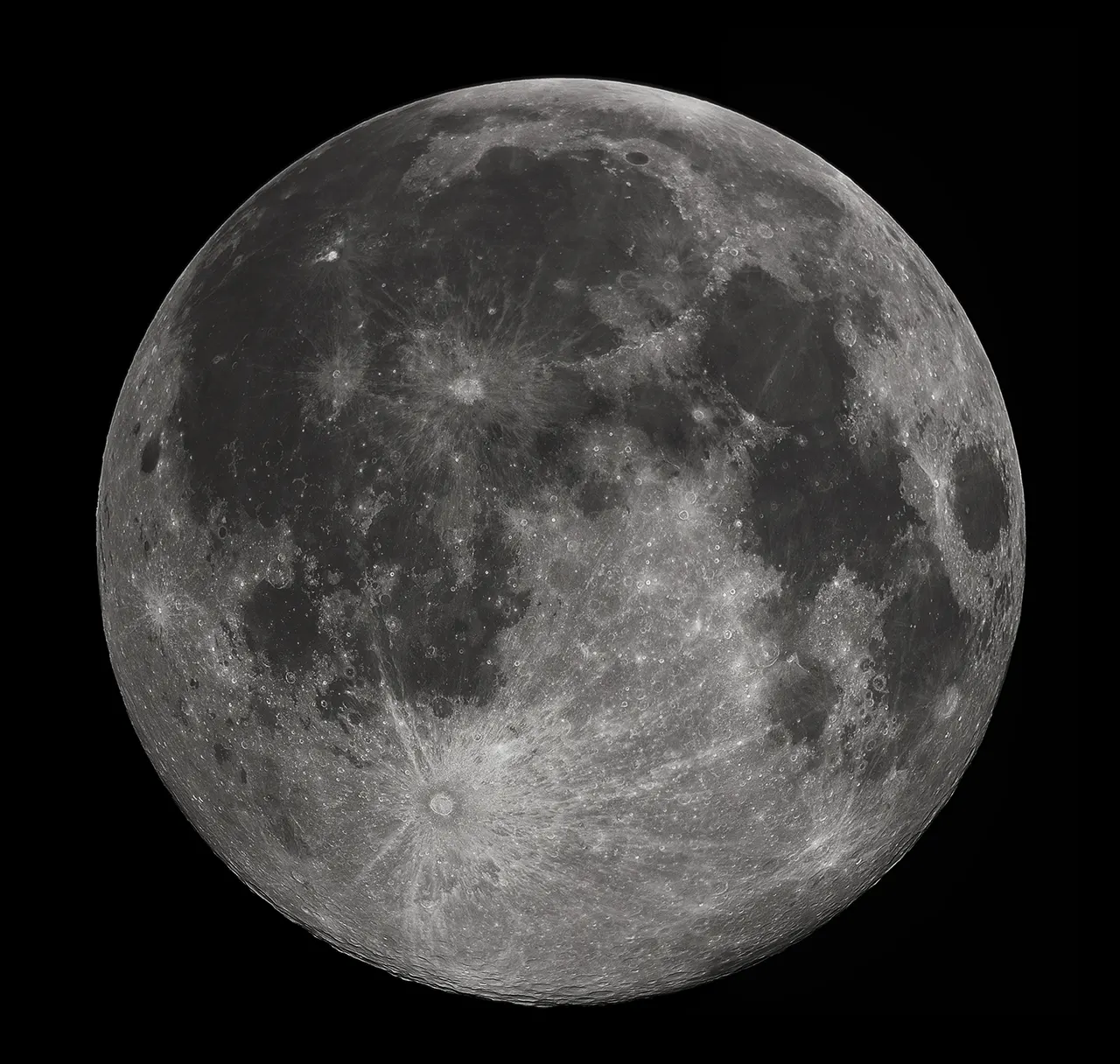
The discovery of hematite at high lunar latitudes indicates that the Moon, once thought to be a chemically stagnant environment, is actively rusting due to its proximity to Earth. Shuai Li of the University of Hawaii first identified this unexpected signature while analyzing data from NASA’s Moon Mineralogy Mapper (M3) aboard India’s Chandrayaan-1 orbiter. Li noted two distinct absorption dips at 0.85 and 0.66 micrometers in the light reflected from polar slopes—wavelengths that precisely match the signature of hematite found in terrestrial laboratories. This finding, published in Science Advances in September 2020, challenged the long-held belief that the Moon’s environment was too reductive for such oxidation to occur.
Hematite is a form of oxidized iron that has lost electrons, commonly known as rust on Earth and responsible for the distinctive red hue of Mars. Because the Moon is continuously bombarded by hydrogen from the solar wind—a process that reverses oxidation—the presence of this mineral was entirely unexpected.
- Hematite traces were found concentrated on the Moon’s near side and near the polar slopes.
- Oxygen from Earth’s atmosphere may be traveling to the Moon during a specific window each month.
- Laboratory experiments involving ion bombardment have simulated both the formation and reversal of lunar rust.
- Recent microscopic analysis of samples from China’s Chang’E-6 mission has confirmed the presence of hematite on the lunar far side.
Why was the Moon thought to be incapable of rusting?
The Moon was considered incapable of rusting because it lacks the two essential ingredients for oxidation: significant oxygen and liquid water. On Earth, an iron nail will redden in days when exposed to the elements, but the Moon is an exceptionally dry environment. Furthermore, the Moon lacks an atmosphere to protect it from the solar wind, which is primarily composed of hydrogen. This hydrogen embeds itself into the top layers of lunar soil, acting as a reducing agent that strips oxygen away from iron. Samples returned by the Apollo missions showed that lunar iron exists almost exclusively in metallic form or as divalent iron, with the trivalent iron found in rust making up less than 1% of the weight.
In the mapping data provided by Li, hematite signatures appeared almost exclusively beyond 60 degrees latitude in both hemispheres. Estimates suggest that in these specific regions, hematite could constitute between a few percent and 10% of the soil by weight. These traces were most concentrated on slopes facing the east or the equator, such as the eastern walls of craters. Notably, the side of the Moon that always faces Earth contained significantly more hematite than the far side.
Is oxygen traveling from Earth to the Moon?
Earth’s atmosphere appears to be the primary source of the oxygen required for lunar rusting, particularly on the side of the Moon that faces our planet. Earth’s magnetic field is compressed by the solar wind into a long "magnetotail" that extends hundreds of thousands of kilometers into space. For several days each month during the full moon phase, the Moon passes through this magnetic tail. According to NASA, this tail acts as a shield, blocking more than 99% of the solar wind’s hydrogen from reaching the lunar surface, thus pausing the reduction process that usually prevents rust.
This magnetotail is not empty; it serves as a corridor for terrestrial particles. In 2017, a team led by Kentaro Terada of Osaka University published findings in Nature Astronomy showing that the Kaguya satellite detected oxygen ions from Earth’s upper atmosphere within this tail. This "Earth wind" provides the necessary oxygen for hematite to form during the brief window when the Moon is shielded from the solar wind. This explains why the near side, which receives the brunt of this oxygen flow, is more heavily oxidized than the far side.
The lunar poles play a unique role due to the angle of the solar wind. At the equator, hydrogen hits the surface directly, but at higher latitudes, it strikes at an angle, reducing the concentration of hydrogen per unit area. At 75 degrees latitude, hydrogen levels drop to 26% of those at the equator; at 85 degrees, they fall to just 9%. Because steep crater walls remain in shadow for parts of the day, they receive even less hydrogen, allowing hematite to persist. Scientists also hypothesize that water molecules released by micrometeorite impacts could act as a catalyst for these chemical reactions in the polar regions.
Notes and Sources
- Li, S., Lucey, P. G., Fraeman, A. A., Poppe, A. R., Sun, V. Z., Hurley, D. M. and Schultz, P. H. (2020). Widespread hematite at high latitudes of the Moon. Science Advances 6(36).
- NASA Jet Propulsion Laboratory (September 2020). The Moon Is Rusting, and Researchers Want to Know Why. Press release.
- Terada, K., Yokota, S., Saito, Y., Kitamura, N., Asamura, K. and Nishino, M. N. (2017). Biogenic oxygen from Earth transported to the Moon by a wind of magnetospheric ions. Nature Astronomy 1.
- Zeng, X., Jin, Z., Dong, C., Huang, Z., Zhu, M.-H., Xu, L., Morrissey, L. S. and Wang, L. (2025). Earth Wind-Driven Formation of Hematite on the Lunar Surface. Geophysical Research Letters 52(17).
- Li, C., Hu, H., Yang, M.-F. et al. (2024). Nature of the lunar far-side samples returned by the Chang'E-6 mission. National Science Review 11(11).
- Liu, Y., Cao, H., Li, R., Chen, J. et al. (2025). Discovery of crystalline Fe2O3 in returned lunar soils. Science Advances 11(46); Chinese Academy of Sciences press release, Nov 13, 2025.