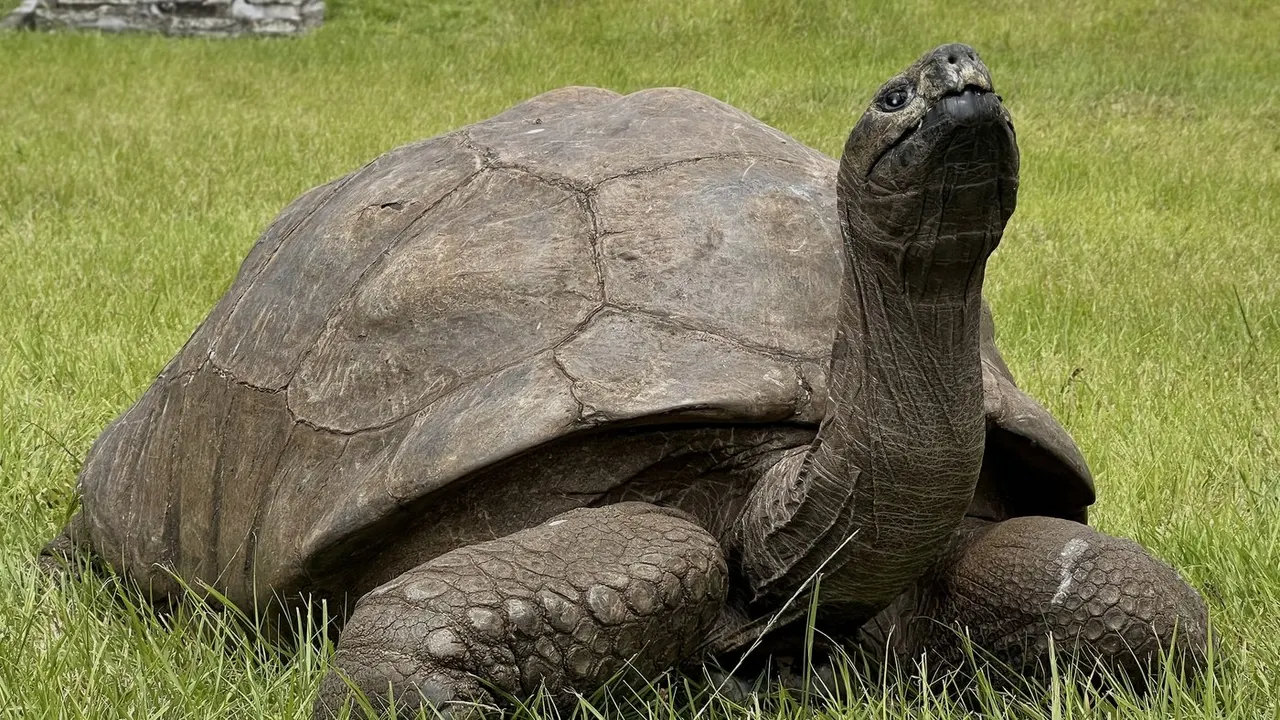
A genetic study published in Science Advances on October 7, 2026, has mapped the epigenome of Jonathan, a 194-year-old Aldabra giant tortoise living on the South Atlantic island of Saint Helena and recognized as the world's oldest living land animal. In 2017, island veterinarian Joe Hollins collected oral cheek swabs from Jonathan, yielding broken DNA fragments that enabled researchers to assemble his sequence against a reference genome and analyze the chemical markers governing his gene expression. The analysis uncovered unique gene variations and remarkably stable promoter regions that may help explain his extraordinary longevity.
Drawing blood from Jonathan was strictly forbidden. Government authorities on Saint Helena refused to risk an infection in the island's most famous resident, granting permission for a 2017 request from US researchers only on the condition that samples be collected from inside his mouth. Dr Hollins performed the swab in the early morning before grass debris could contaminate the sample. Pretending to feed the giant tortoise, he held Jonathan's mouth open with a gloved hand once the animal began snapping at the air, using his other hand to gently scrape cells from beneath the tongue. Staff from Patrick Space Force Base in Florida then transported the samples off the island.
The findings mark the first time researchers have mapped the epigenome—the chemical tags that turn genes on and off—in a giant tortoise. The results provide an unprecedented look at how molecular controls endure across nearly two centuries of life.
How old is Jonathan the giant tortoise?
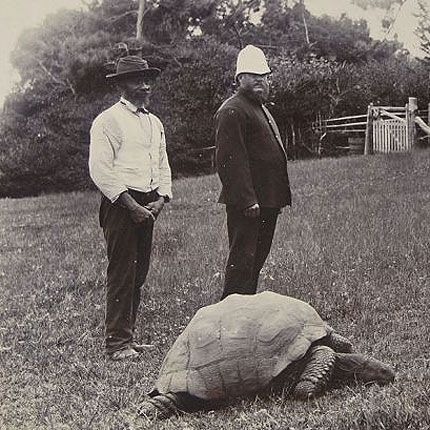
Jonathan the giant tortoise is estimated to be at least 194 years old, based on historical shipping records from 1882 that documented his arrival on Saint Helena as a fully mature adult. Because Aldabra giant tortoises reach full adulthood at a minimum age of 50, Guinness World Records places his birth year no later than 1832, making 194 a conservative lower limit rather than an exact count. A photograph taken at the governor's residence, Plantation House, between 1882 and 1886 shows Jonathan fully grown just a few years after his arrival on the island.
Demographic data underscores how far Jonathan has exceeded the natural boundaries of his species. An analysis of zoo records from the Species360 database indicates that male Aldabra giant tortoises have a mean total lifespan of 80.5 years and an upper threshold of 93.7 years. Jonathan has surpassed that expected upper limit by approximately a century.
What did scientists find in Jonathan's genome?
Researchers analyzing Jonathan's cheek swabs extracted short, fragmented DNA samples totaling 165 billion base reads, aligning 93 percent of them against a complete reference genome built from the blood of Tank, a 36-year-old Aldabra giant tortoise housed in the United States. The comparison revealed 6.9 million reliable genetic variants, while lineage mapping linked Jonathan closely to the Grande Terre tortoise population of the Aldabra Atoll, alongside ancestry components unmatched in known reference groups.
The research team evaluated Jonathan's sequence against Tank, the human genome, and Lonesome George—the famous Pinta Island tortoise who died in 2012. Cross-referencing a curated list of aging-related genes compiled during a 2019 study of Lonesome George revealed 287 genes carrying amino-acid-altering mutations unique to Jonathan. Protein language models flagged 41 of these as functionally significant, including 12 established longevity genes such as POT1 and ACD (which protect telomeres), ERCC1 and TP53BP1 (which orchestrate DNA repair), and FOXO3 (associated with exceptional human lifespan in Okinawa).
The study also revealed gene duplications associated with cellular regulation and immune defense. Jonathan possesses two copies of LAMTOR4—a key component of the nutrient-sensing mTOR signaling pathway—with two unique mutations predicted to partially dampen pathway activity. Additionally, researchers counted 10 copies of the perforin gene in Jonathan's genome, compared to 7 copies in Lonesome George, suggesting an enhanced immune capacity to eliminate senescent or malignant cells.
Why are Jonathan's gene switches so stable?
Jonathan's gene switches retain exceptional chemical order because methyl groups on his DNA promoter regions have resisted the random decay typically brought on by aging. As organisms grow older, epigenetic marks gradually lose their organization—a disorder known as methylation entropy. When entropy rises within promoter regions at the start of a gene, the cell's control over gene expression becomes erratic and unpredictable.
To evaluate this decay, the research team compared Jonathan's oral cell methylome with those of four other Aldabra tortoises: a 5-year-old juvenile, a 12-year-old named Smalls, and two males named Toka and Poka whose exact ages are unknown but who were documented as adults in 1969. While genome-wide entropy increased along a predictable line with age—leaving Jonathan with the highest overall disorder—promoter regions revealed a striking exception.
Out of 2,895 promoter regions consistently mapped across all five animals, 272 maintained high structural order in Jonathan and the two young tortoises, while displaying entropy in Toka and Poka. Among these preserved sequences, 35 govern mitochondrial energy production, 25 handle RNA processing and protein synthesis, and 15 direct DNA repair and telomere maintenance. Dr Justin Gerlach, a tortoise ecologist at the University of Cambridge, noted that these energy and repair regulators remained remarkably stable in Jonathan across nearly two centuries. The study authors drew parallels to a 2025 analysis of Maria Branyas, who died in 2024 at age 117, which found that her mitochondria functioned with extraordinary efficiency compared to her peers.
What are the limitations of the Jonathan tortoise study?
The study of Jonathan carries notable scientific constraints, as reliance on non-invasive oral swabs prevented researchers from collecting intact blood samples for long-read sequencing or RNA extraction to confirm whether his unique genetic variants actively alter protein function. The promoter analysis covered only about 10 percent of the total promoter regions across the genome. Furthermore, with a comparative sample of just five Aldabra tortoises, researchers cannot yet determine whether this epigenetic pattern is specific to Jonathan or represents a broader trend within the species.
The study authors explicitly noted that their dataset cannot establish a direct causal link between preserved promoter order and extreme lifespan. Funding for the research was modest, supported by a $50,000 grant from the Stephen Voland Research Fund, according to Vanderbilt University Medical Center. Senior author Stephen Clark serves as the founder of the Kallel Foundation, a non-profit organization dedicated to longevity research.
Definitive confirmation will depend on deeper methylation mapping through blood sampling. Today, Jonathan suffers from cataracts and a diminished sense of smell, though his hearing remains intact. According to the official birthday assigned by the government of Saint Helena in 2022, Jonathan will reach 194 years of age on December 4, 2026.
Notes and Sources
- B. Vaisvil, D. P. Schmitt, A. Jones et al. (2026). "Epigenetic insights into extreme longevity in the world's oldest terrestrial animal, Jonathan". Science Advances 12. DOI: 10.1126/sciadv.adw8887
- University of Cambridge (October 7, 2026). "Genetic analysis of the world's oldest land animal reveals secret of living 194 years". cam.ac.uk
- Guinness World Records (2022). "Oldest land animal (living)" and "190-year-old Jonathan becomes world's oldest tortoise ever". guinnessworldrecords.com
- V. Quesada, S. Freitas-Rodríguez, J. Miller et al. (2019). "Giant tortoise genomes provide insights into longevity and age-related disease". Nature Ecology & Evolution 3, 87-95. DOI: 10.1038/s41559-018-0733-x
- E. Santos-Pujol, A. Noguera-Castells, M. Esteller et al. (2025). "The multiomics blueprint of the individual with the most extreme lifespan". Cell Reports Medicine 6, 102368. DOI: 10.1016/j.xcrm.2025.102368
- Bill Snyder, Vanderbilt Health News (October 7, 2026). "An extremely old giant tortoise named Jonathan may hold the secret to a long, healthy life: Study". news.vumc.org