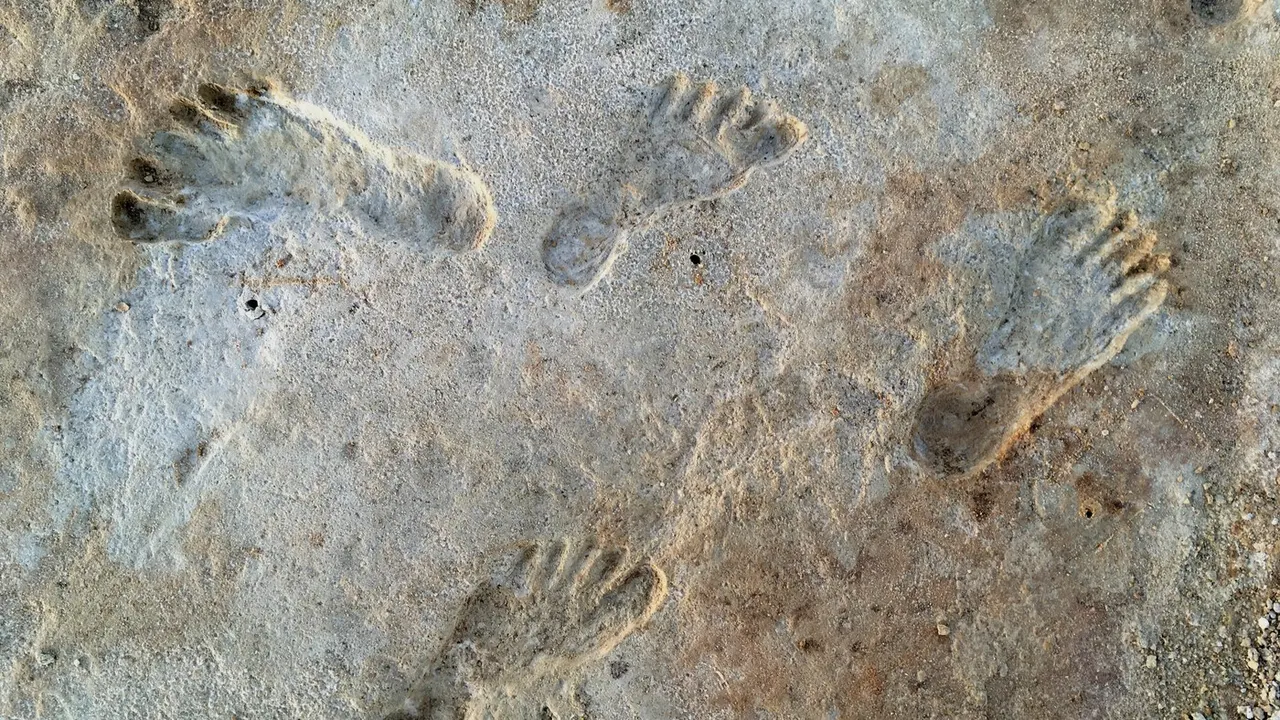
A research team from the U.S. Geological Survey (USGS) and the National Park Service returned to White Sands National Park in New Mexico in January 2022 to expand on work begun two years earlier. By extending an 11-meter trench to 25 meters, they exposed a sediment wall measuring approximately 2.7 meters rather than the initial 1.3 meters. This wall revealed 20 separate layers containing human footprints, significantly increasing the count from the seven layers identified during the first excavation.
The findings were published in 2026 in the journal Science Advances. The tracks date to between approximately 23,500 and 21,700 years ago, placing them firmly within the coldest phase of the last ice age. The team did more than just date the site; they reconstructed the climate of the ancient lakeshore in roughly 50-year increments using the same mud in which these individuals walked.
- How did researchers address challenges to the dating of the footprints?
- What impact did climatic shifts recorded in Greenland ice have on the New Mexico lake?
- Who left the majority of the 152 measured tracks?
- Does an absence of tracks during certain years imply an absence of humans?
What was the objection to the age of the footprints and how did new dating methods resolve it?
These tracks were first published in the journal Science in 2021. Matthew Bennett and his team initially dated them using the seeds of the aquatic plant Ruppia cirrhosa, yielding a result between 23,000 and 21,000 years ago. This predated the generally accepted timeline for human settlement in the Americas by thousands of years. Critics pointed to a potential flaw: old carbon dissolved in lake water could give aquatic plants an apparent age much older than their actual life span, a phenomenon known as the "hard water effect." In 2023, the team provided independent dates using conifer pollen and optically stimulated luminescence, which measures the last time sand grains were exposed to sunlight. The results remained consistent. The team's work also addresses how these findings correlate with genetic data regarding the initial migration to the Americas.
In the new study, the margin of error for pollen ages was reduced fivefold. To measure foreign carbon introduced by the laboratory into the samples, the team used pollen older than 110,000 years from the Ziegler Reservoir in Colorado. Up to 75,000 pollen grains were isolated individually from each sample using a laser-based sorting device. A discrepancy of up to 1,330 radiocarbon years was found between pollen and seeds in the same layer, confirming that the seeds had indeed been affected by hard water. When corrected, the footprints remain firmly dated between 23,500 and 21,700 years ago.
How did the lake evolve over two thousand years of climate change?
To reconstruct the climate, the team analyzed three lines of evidence in the sediment. Pollen grains indicated which tree species grew in the surrounding mountains, while molecules from plant leaf waxes carried the chemical signature of rainwater. Oils remaining from the membranes of bacteria and single-celled archaea provided data on air temperature and water salinity. When the record began approximately 24,200 years ago, the excavation site was submerged under Lake Otero. Pine-dominated mixed conifer forests occupied the hillsides, with pollen from these forests accounting for 40 percent of the total. The average annual temperature was around 12 degrees Celsius, about 4 degrees lower than today. At 23,600 years ago, the lake began to recede. Increased evaporation due to warming weather caused forests to be replaced by oak and sagebrush. By 22,400 years ago, the warming had accelerated, and the basin was drying out.
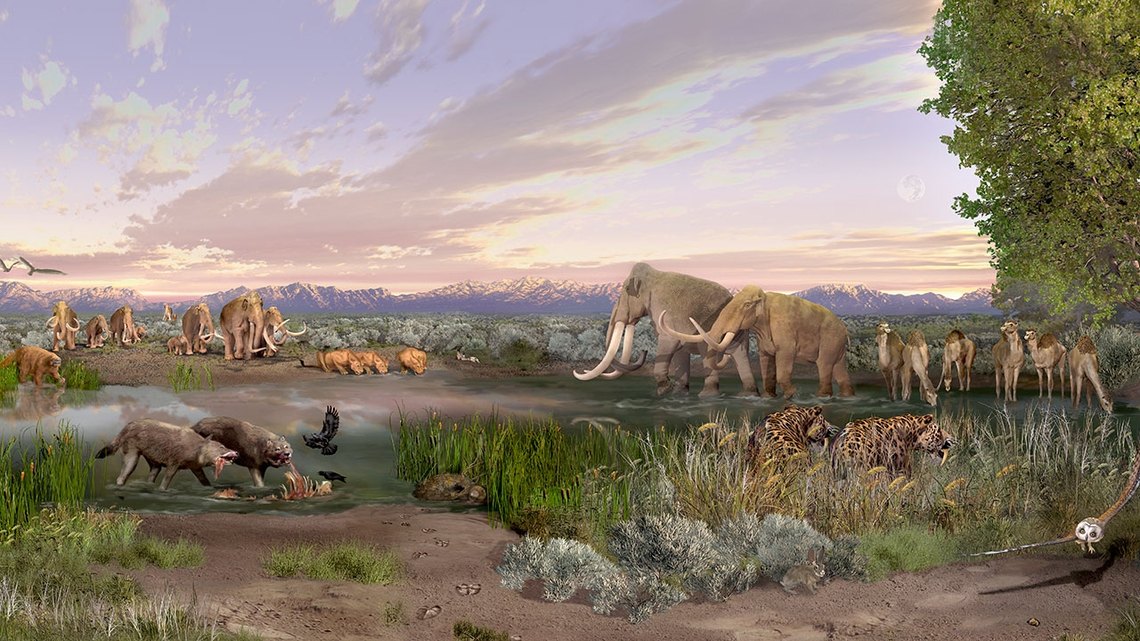
This warming trend is inconsistent with general climate patterns across the Northern Hemisphere. During the period between 23,000 and 18,000 years ago, the Northern Hemisphere average was cooling. The team compares the warm trend at White Sands to sea surface temperature records off the coast of California, suggesting that the ice sheet covering North America may have altered regional wind patterns.
Notes and Sources
- Springer, K. B., Pigati, J. S., Tierney, J. E., Honke, J. S., Jiménez-Moreno, G., Bustos, D. et al. (2026). "Humans experienced abrupt environmental changes at White Sands during the Last Glacial Maximum". Science Advances 12: eaeh0707.
- Bennett, M. R. and Reynolds, S. C. (2026). "Tracks of Coincidence: How Climate and Human Presence Shape the Fossil Footprint Record". Fossil Studies 4(3): 22.
- Bennett, M. R., Bustos, D., Pigati, J. S., Springer, K. B. et al. (2021). "Evidence of humans in North America during the Last Glacial Maximum". Science 373(6562): 1528-1531.
- Pigati, J. S., Springer, K. B., Honke, J. S. et al. (2023). "Independent age estimates resolve the controversy of ancient human footprints at White Sands". Science 382(6666): 73-75.
- Bennett, M. R. and Reynolds, S. C. (October 2026). "Early humans in America endured climate chaos: new research". The Conversation; Phys.org.
- Rasmussen, S. O., Bigler, M., Blockley, S. P. et al. (2014). "A stratigraphic framework for abrupt climatic changes during the Last Glacial period based on three synchronized Greenland ice-core records". Quaternary Science Reviews 106: 14-28.