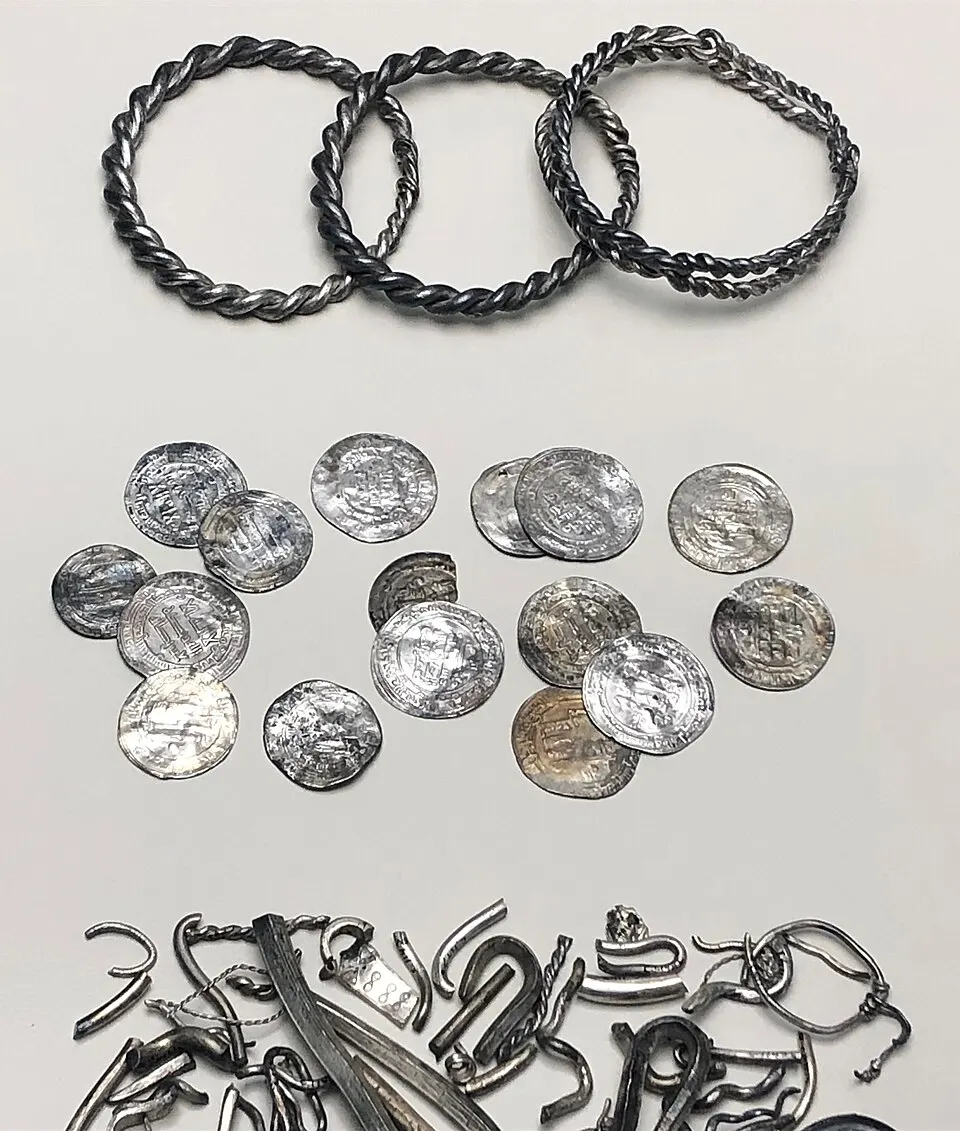
A rare silver coin struck for the Norwegian king Olaf Haraldsson, once misidentified as Anglo-Saxon currency, has been declared a national treasure, marking the fifth known example of the type.
Since the start of the summer, Anne Skogsfjord has been cataloging Viking-era silver coins one by one at the University of Oslo's Museum of Cultural History. The specific coin in front of her had been mixed into a pile of money attributed to the English King Aethelred the Unready during initial sorting because of the strong visual resemblance. Skogsfjord paused when she read the text around the rim: ONLAF R+ NORMANORV, meaning 'Olaf, King of the Norwegians.'1
The coin was struck in the name of Olaf Haraldsson, who ruled Norway from 1015 to 1028 and was canonized as a saint after his death. Skogsfjord immediately rushed to a colleague's office to share the discovery. She later described that moment as the instant she realized they had found a national treasure.1
How rare is this specific type of Viking coin?
There are fewer than 20 surviving coins struck for Olaf Haraldsson, and the majority were found outside of Norway. The king had three distinct coin types in circulation, all of which modeled their design on Anglo-Saxon currency. For the specific type discovered at Mørstad, only four other examples had been known prior to this find. Three of those previously known coins are located in Sweden. The sole example previously found in Norway was unearthed in 1924 at the ruins of the Stein church in Ringerike and is currently held in the collection of the Coin Cabinet in Oslo.1
What do the coin's features reveal about the era?
The obverse displays the king facing left, wearing a conical war helmet, a design feature that earned the type the nickname 'Sharp Helmet.' The reverse features a cross surrounded by a Latin inscription: +CE DVX DOMINNVS MEI, which translates to 'my leader, my lord.' The final letters are worn on this specific specimen, but museum curators have identified them by referencing other coins struck from the identical die.1
The designation of 'national treasure' is not a formal legal title in this context. The term was first used by Skogsfjord and subsequently adopted by Jon Anders Risvaag, a numismatist at the Norwegian University of Science and Technology (NTNU) in Trondheim.3 The legal status of the object is determined by existing regulations. Under Norway's cultural heritage law, any human artifact from before the Reform of 1537 is automatically protected. As a result, hoards such as this one are considered the property of the public and must be studied by the Museum of Cultural History.7
Why did the king mint coins if they were not intended for trade?
Svein H. Gullbekk, a professor of numismatics at the Museum of Cultural History, believes that Olaf himself determined the design of these coins and may have even been present during the minting process. The faces of the king and Christian symbols like the cross appear on both sides of the piece. Gullbekk characterizes the coin as a large-scale act of Christianization. According to his analysis, Olaf used the currency to enforce the new religion and to present himself as a Christian sovereign equal in status to the other kings of Europe. Gullbekk describes the endeavor as a straightforward exercise in royal branding.2
Risvaag shares a similar perspective. Coins of Olaf Haraldsson, like those of his predecessor Olaf Tryggvason, were struck in small quantities specifically because they were not expected to enter into regular circulation. The first coin of Norway is considered to be the penning struck by Tryggvason between 995 and 998. Genuine coinage production in the country did not begin until the reign of Harald Hardraade. Risvaag argues that Olaf minted these coins to demonstrate that he was capable of performing the same acts as the kings abroad.3
This particular specimen does not appear to have remained in a safe, however. Small knife hacks are visible on both sides of the coin. During that period, merchants would cut into the silver to verify the metal's purity and authenticity when settling payments. The coin was struck between 1024 and 1028. Researchers believe it changed hands several times during the 20 to 25 years that passed before it was buried in the ground.3
Olaf lost his throne only a few years after the minting of this specific coin. He died in the Battle of Stiklestad in 1030, and the church canonized him as a saint in 1031.1
Notes and Sources
- Innlandet County Administration (Oct. 8, 2026). "Sensasjonelt myntfunn i Mørstadskatten" [Sensational coin find in the Mørstad Hoard]. Innlandet County Administration cultural heritage announcement.
- Riksantikvaren (Oct. 9, 2026). "Sensasjonsfunn i vikingmyntskatten" [Sensational find in the Viking coin hoard]. Norwegian Directorate for Cultural Heritage announcement; statements by Svein H. Gullbekk and Hanna Geiran.
- Bergstrøm, I. I. (Oct. 9, 2026). "Sensasjonelt myntfunn: – Vi har funnet en nasjonalskatt" [Sensational coin find: "We have found a national treasure"]. forskning.no; interview with Jon Anders Risvaag (NTNU).
- Riksantikvaren (April 29, 2026). "Fant historisk myntskatt fra vikingtiden" [Historical coin hoard from the Viking Age found].
- Wenn, C. C. (June 1, 2026). "Mørstadskatten: Metalldetektorfunn og påfølgende sikringsundersøkelse i Åmot, Innlandet" [The Mørstad Hoard: Metal detector find and subsequent safeguarding investigation in Åmot, Innlandet]. University of Oslo Museum of Cultural History presentation; ground-penetrating radar data: Gustavsen, L. (2026), NIKU report 597.
- Bergstrøm, I. I. (Sept. 29, 2026). "Rekordskatten fra vikingtiden: Mynt nummer 5.000 er nå gravd opp" [The record hoard from the Viking Age: Coin number 5,000 is now excavated]. forskning.no.
- University of Oslo Museum of Cultural History (Oct. 9, 2026). "Mørstadskatten: Norges største myntfunn fra vikingtiden" [The Mørstad Hoard: Norway's largest coin find from the Viking Age]. Exhibition page (Nov. 20, 2026 - March 28, 2027).
- Bergstrøm, I. I. (April 29, 2026). "Har funnet 3.000 mynter fra vikingtiden: – Helt uten sidestykke" [3,000 coins from the Viking Age found: "Unique"]. forskning.no.
Images: cover, both sides of the Olaf Haraldsson coin, Lill-Ann Chepstow-Lusty / Museum of Cultural History (Riksantikvaren press image). Coins and finder: Anne Engesveen, Innlandet County Administration. Counting graph: based on research data.